Guest blog: Author Will Brodie’s two hockey lives

WORLD EXCLUSIVE: Nicko writes: I met Will Brodie through mutual writing/journalism friends quite a few years ago, and before my hockey adventure began, so the fact that he’d played as a kid didn’t resonate with me at the time, as it does now. However, as he’s rediscovered his love of the sport, and played a vital role in getting media oxygen for the AIHL at The Age Online, and now through his excellent book, ‘Reality Check‘, it’s been fun to see him reestablish himself in our crazy world. A while ago, I invited hockey players to write for the blog and had a series of guest writer ‘origin stories’ as a result. That offer has always remained open (and remains open, for anybody who wants to tell their story). Will found time, between marketing and selling ‘Reality Check’, to tell his yarn. Here it is:

A tale of two hockey lives

By Will Brodie When I chatted to Nick Place about his hockey journey, he remarked that the experience of those who first played in the 1970s was unknown to many of those who have taken to the sport since the advent of the Icehouse. He suggested I write about my origins in hockey and what it was like back then, and I was keen to share reminiscences of a formative, fondly remembered era.

Will Brodie, centre, as a young Blackhawk in 1977. With his best mates, Glenn and Tim.

Will Brodie, centre, as a young Blackhawk in 1977. With his best mates, Glenn and Tim.

I have had two hockey lives. My first began when I was a young child in the early 1970s, when I used a sawn-off stick as I mucked about with mates including Glenn and Tim Grandy at our Dads’ senior Blackhawks practices early on Sunday mornings. When senior scrimmage took over the entire ice surface, we repaired to the worn floorboards of St Moritz to improvise endless games with pucks made from balled-up discarded stick tape (suspiciously like electrical tape in those days). If we bribed our fathers at the right moment we would get cokes in small bottles, a style revived decades later as a ‘retro’ marketing/packaging ploy. Later we all played together in the Blackhawks juniors, starting as 10-year-olds playing under-16s. When I was 14, playing a game of footy and two games of hockey each Sunday, I hurt a knee, perhaps inevitably. The initial niggle came in a way unique to rough rinks in those days – condensation or leakage from the roof dripping down and forming nasty little yellow stalagmites which rose off the ice surface. I skated over one, felt a twinge and a later tackle from behind in a footy game finished my cartilage off well enough for me to spend weeks on crutches. Living on the suburban/urban fringe, I had started attending school in the city and, when I recovered, the prospect of training at midnight Friday – with a merged team which included members of our previous arch-rivals – was not enough to bring me back. I never made a decision to never again play, merely not to play that year, then the usual adolescent distractions intervened and by the time I was into young adulthood, the five-rink league of my youth had shrunk to just Oakleigh. As I write in Reality Check: “I meant to get back to hockey but never did”.

All hail the 1977 junior Blackhawks.

All hail the 1977 junior Blackhawks.

This first age of hockey of mine was blessed by a golden age of rinks in Melbourne. Like visiting VFL home grounds, playing at Footscray, Ringwood, St Moritz and Oakleigh was exciting and fascinating, each rink possessing a unique atmosphere. Dandenong was a good size, but felt like the converted factory it was; St Moritz was a magnificent faded relic, all art deco timber, and all too vulnerable to a cynical match; Footscray was always wet and less scary than you thought it would be; Ringwood was like the MCG of the sport, housing the slick Rangers and home to the brief incursion of the sport on to ABC TV; Oakleigh was the tiny, combative rink where they played stirring American marching band anthems ahead of senior finals games.

The old Ringwood rink. Man, couldn't we use that now!

The old Ringwood rink, ‘The MCG of the sport’. Man, couldn’t we use that now!

We played the Monarchs, Pirates, Hakoah, Rangers … Many of the clubs familiar to players these days are unfamiliar to me. Jets? Sharks? They are long-established but they were the product of mergers or changes which came long after my playing career. When we weren’t playing, we were often forming a very small, shrill cheer squad for the seniors, banging on the hoardings at the Dandenong Coliseum. When I walk through the Icehouse’s St Moritz bar these days, many of the names on the trophies are those of friends of my Dad that we cheered for, friendly hockey types who held court at the backyard barbecues where Glenn and I played hockey with fallen lemons. My Dad and his hockey friends consistently lunched long on Fridays, bottled wine to raise funds for the club and the Australian national team and went on holidays with their families together. They eventually all bought a property together, in the glorious bush of the Victorian Great Dividing Range. I still camp on that property with my family. Old hockey sticks were redeployed alongside our tents as prospective ‘bong-bong’ sticks in case errant snakes strayed too close to habitation. My brother still has a relic of one of those sticks, a shrunken red Titan. To me, Titan sticks were the fancy newcomer – I had grown up accustomed to KOHO and Sherwood, but such is the foreshadowing of memory; Titans were probably around for most of my childhood. The first impressions remain the strongest.

Hockey as Will Brodie used to know it: The 1977 Australian team that played West Germany.

Hockey as Will Brodie used to know it: The 1977 Australian team that played West Germany.

My second hockey life began in 2010 when my brother Craig took me to a game at the recently opened Icehouse. I fell back in love with the game instantly, amazed at the venue – the seemingly grandiose, unrealistic dream of decades previous made real – and the remarkable crowds, but mostly just the game itself, better than it had ever been played in Australia, and presented so much more ‘professionally’, with music and announcers. My hockey renaissance via the Icehouse came at around the same time Nick and so many others were taking their newfound enthusiasm to the next level by buying skates, taking lessons and learning how to play. Nick is a wholehearted sort of hockey lover – he had to play, not just watch. For those of us who have played but been away for a long time – the itch to play again never goes away. There is nothing like playing hockey. If you don’t play for a long time, it seeps into your dreams. I had my first skate in 30 years in mid 2012 and did my (other) knee (on terra firma) a week later. I don’t drive, I am not wealthy and my lower limbs are faulty – returning to playing hockey is not an easy choice to make at 48, especially when I have such vivid memories of being a competent junior. But the more I watched, the closer I got to the players and the ice surfaces by writing my book about the AIHL in 2014, the more the hockey dreams returned. The smell of sweat in the cold. The smell of lacerated rubber matting, decades old. The clacking sound of sticks, skates, pucks, boards. It is little wonder that the subconscious is activated by hockey – while one is sleeping, the most affecting sensations have their run of the mind and soul. Asleep, there is no rational mind saying ‘you’re too old/hurt/poor to play again’. My hockey dreams bring back very specific moments and sensations. I remember the jelly-legged fear and excitement when pulling up at a foreign rink ahead of a game. I remember the intoxicating odour drift of exhaust in the pre-dawn fog at Sunday morning practices as a diesel-powered tractor with chains on its tyres trudged up and down to clean the ice. The same tractors I would see in the fields near our camping getaway; Massey Fergusons rolled through my childhood like pets. I remember the forbidding holes at the corners of some rinks where snow was shoved down by flat, wide person-powered shovels. The red digital scoreboards which glowed either warmly or tauntingly depending on the numbers they exhibited.
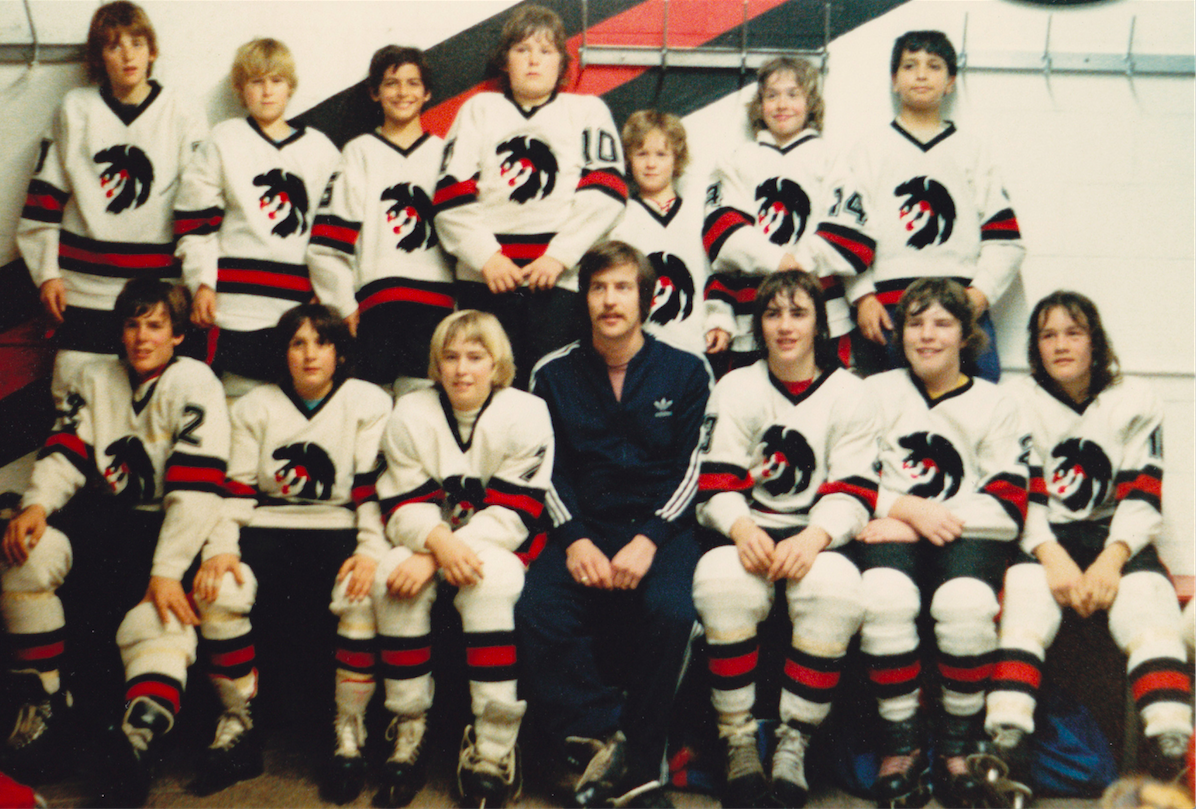
1980 Blackhawks, featuring Will Brodie. You can tell they're hockey players because nobody is looking at the right camera.

1980 Blackhawks, featuring Will Brodie. You can tell they’re hockey players because nobody is looking at the right camera.

I recall the completion of pulling a jersey over your gear before a game, and suddenly being transformed into a player; the perfect satisfaction of a pass setting up a goal-scoring mate; the oxygenated agony of stops and starts; the post-practice glow, with all of Sunday still stretching ahead; ignominious losses that taught me that teams beat talent; the sensation of gliding a circle after having hustled for speed; the sensation of beating a goalie, sometimes a mystery worthy of In Search Of investigation, sometimes as simple as just being there in the slot. The game gets brutal at about the point I left it as a teenager – the need for elite physical conditioning and mental and physical toughness kicks in and angsty veins pump anger around the rinks. I may not have been tough enough to go far in hockey, and I was certainly not a good enough skater to end up playing for Australia like Glenn did. But if I had learned how to handle myself, I would have enjoyed that rush and slide of hockey for a lot longer. Truth is, when the game shrank to just Oakleigh, it took rare dedication to keep rocking up, travelling long distances, putting up with yet another year of the cold. You had to be a complete hockey tragic, and thank god there were enough of those wonderful beasts to keep the sport going. And thank god for the Icehouse, which gave the softer hockey lovers like me somewhere to reignite our passion for the game. If I was to play again, I would want to start by marching from Huntingdale station to brave frigid old Oakleigh. For the first time with a stick in my hands at least, I would have to reconnect with the rough charms of my childhood hockey, where everything is reduced to your skates, your stick, the ice and your teammates. Then I would accept the luxury of the Icehouse without shame, and maybe pull some strings to get them to put on that John Phillip Sousa marching music so I could imagine I was about to play a senior final. * * * * * * * * * * * * * * * * * * * * * THE PLUG: Will Brodie’s new book, Reality Check, is a personal account of following the Melbourne Mustangs and the Melbourne Ice through the 2014 AIHL season. Will went on all the road trips with the teams and hung out behind the scenes at the Icehouse. It’s a beautifully crafted and fascinating account of an exciting year in the AIHL, and the players, coaches and volunteers who make hockey happen in this country. I fully recommend it, and not just because Will is a mate. It’s a cracking read! CLICK HERE TO PURCHASE REALITY CHECK.

Becoming what you might have been.

‘It’s never too late to be what you might have been.’

I love that truism, even if it works better in some contexts than others. This week, for example, has been a pretty stern test for George Eliot’s quote, and also a stark example of the difference between sport and life.

Andrew Chan and Myuran Sukumaran used their entire 10 years in a Bali prison to try to become the men they might have been, had they not been dickhead enough to try and smuggle heroin in their early 20s. They seem to have succeeded, except for the fact that a dick-swinging Indonesian president, elected on a hardline agenda when it comes to his country’s drug problem, decided the two Australians’ lives were better used as collateral that could deliver popularity, instead of recognising their work to become better people.

As has been endlessly reported, Chan used his time in jail to explore Faith, and devoted himself to making other prisoners’ lives better in his finite time left on Earth. Sukumaran painted, expressed himself, laughed a lot, and reportedly evolved into an intelligent, gentle giant, to the point that the act of shooting him in the heart most definitely felt like murder rather than justice.

In the end, Eliot was wrong: they could not out-run that one massive mistake of their youth but, by the time it fatally caught up with them, they at least were able to stand tall, somehow seen by the wider community as more inspirational than dirty drug mules. (And none of this is to suggest that their original crime was okay: I am vehemently anti hard drugs and the people who would bring them into Australia. I just acknowledge the criminals’ rehabilitation.)

Of course, there’s not much of a link between that whole sorry business and hockey, and especially this now-half-century-old Melbourne struggler.

Except that those horrific events underline, strongly, how much easier sport is, even when it goes badly, compared to real life. Context can be useful sometimes, when we think the sporting Gods are against us. Hockey and other sports are not actually life-and-death, no matter how energetically some commentators may try to put that spin on it. I was encouraged to see several AFL footballers actively dismissing all the ANZAC Day bullshit that likes to make out that football is war. A couple of players went out of their way, in interviews, to underline that they understand and appreciate the difference; that they’re only playing sport, not facing the unimaginable horrors that soldiers, Turk or Australian, New Zealander or British, did at Gallipoli.

Tiger Nathan Drummond buckles his knee in his first game. Pic AFL Media

Tiger Nathan Drummond buckles his knee in his first game. Pic AFL Media

Yes, a promising young Tiger, Nathan Drummond, made his debut for the club last Friday night against Melbourne only to collapse, in agony, clutching his knee, and duly needed season-ending surgery. That sucks dog balls, as an ex-girlfriend of mine liked to say, but Drummond can come back and try again. He gets to do rehab, and sweat and grit his teeth, and overcome this hurdle.

Even as I watched my ever-frustrating Tigers fail to turn up against a young and committed Demon team that night, falling with depressing meekness in the rain, I could be comfortable in the knowledge that Richmond would get another shot at being the finals-bound team it was resolutely failing to be, this weekend at the MCG versus Geelong. That morning, I had already watched my beloved Red Wings, in the first-round of the NHL play-offs, against Tampa Bay, carry a 2-0 lead deep into the third period, all set to go 3-1 up in the series, only to drop three goals in eight minutes to lose and re-earn their underdog status.

It only took them two days to rediscover the team they might have been, winning big in Tampa Bay, before returning to the Joe and losing again. And so, as I type this, it’s 0-0 at the end of the first period of Game 7 at Tampa Bay, and the Wings may or may not be going through to the second round.

Which will lead to whether Mike Babcock will or won’t remain as head coach next year, as he comes off contract and fields huge offers from a range of teams desperate for him to take over their franchises.

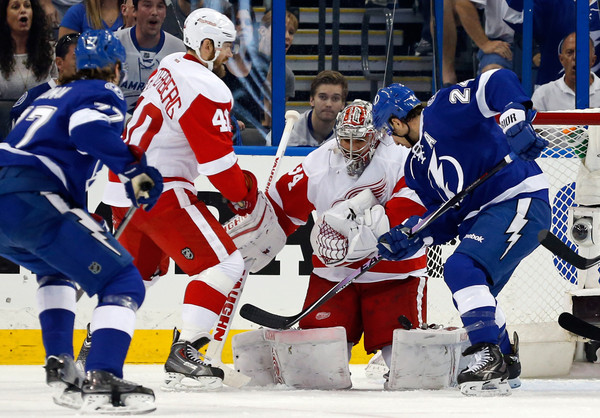
Detroit and Tampa Bay battle it out in the NHL play-offs.

Detroit and Tampa Bay battle it out in the NHL play-offs.

And, if the team has lost today, players will come and go and the team will seek to improve beyond the once-mighty power that hasn’t made it past the first couple of rounds of play-offs for years now. The longest active play-off streak in American sport – 24 years and counting – doesn’t mean much when you get KOed straight away every time.

But, to emphasise, Eliot’s point, they get another shot. Every season. And if Babcock does leave, somebody else will take that chair and the team will evolve in a new direction.

Me? Right now, I feel a long way from the hockey player I might have been, or even am. I’m carrying a nasty head cold and I haven’t written any blogs because I’ve had a month off the ice, getting busy with swapping rings, working hard in two jobs, turning 50, entertaining family from France, doing pretty much anything except regular fitness work. Like everybody, I feel in my head that I am much younger than my chronological age, but I think the one part of hitting my half-century that I’m aware of is that if I stop moving, my body starts to immediately lose its edge. Like a shark that must swim to not drown, I simply can’t take a month off any more without noticing it, and so I’m resting only for as long as it takes to see off this virus and then I simply have to get back on the ice, get back in the gym, ride my awesome new mountain bike and do all the things I usually do to be fit and ready for next summer’s Div 3 action.

The good news is that I have that chance, I have the blessed life that I have, to evolve and explore and see what I can still be in the second half of my life. Hopefully better than I am and I have been.

Chan and Sukumaran, and the six men executed with them, don’t have that chance. But if you’re reading this, you do. Live large, people. Take a moment to breathe, to enjoy the feeling of simply being alive. And then get on with things.


The end of another summer?

Tonight, I potentially play my last game of the IHV Div 3 2014/15 summer season. My team, the Cherokees, has a game next weekend to finish the regular season but I have a wedding I can’t miss and so tonight, at 10.30 pm at the Icehouse against the Champs, is it for me. Except that we’re going to win tonight and therefore play finals in a couple of weeks, but that’s for another blog.

As always, as the end of the official season approaches, I feel melancholy. There are aspects of being in a team, of sharing adventures with the same group of people, that are impossible to capture elsewhere. It’s something I cherish because I only watched it from the outside for so many years as a sports journalist while, as a kid, I was more of a surfer than a footy player and only played indoor cricket with some mates for fun. The Bang, my winter footy world with a bunch of similarly creaky Sherrin-chasers, goes close but we don’t have actual matches, we don’t skate onto the Henke Rink needing to win to make the finals. That sort of adrenalin is hard to bottle.

I haven’t written the blog since returning from Christmas because there hasn’t been much to write about, in a hockey sense. I’ve been training on Wednesdays, very much as per the final blog of last year, where Tommy, Lliam, Army and Shona own our arses in dev league after we complete drills in Inter class. We’ve played some Cherokee games and continue to get more cohesive and dangerous as a team, just as we’re going to have to stop.

In my happy place (pun intended): playing the goon for the Cherokees.

In my happy place (pun intended): playing the goon for the Cherokees.

Away from the rink, I’ve been on an intense fitness campaign – including a non-negotiable minimum of 50 push-ups and 100 sit-ups per day, over and above hockey training, gym workouts and other fitness – and feel great for it. It’s kind of annoying that I feel like I’m hitting peak fitness at the exact moment I’m about to stop playing competitive hockey.

On Monday, I even walked to work, and therefore found myself wandering past the Punt Road Oval just as my beloved Richmond footy team was warming up for training. Somebody had left a gate open and that’s all a former journo needs to sneak in and take a seat … I eventually made myself useful by collecting the balls that were kicked too high for the epic netting behind the goals (about one in five shots), so that I felt like a little kid again, scurrying around behind the goals at the school end of Lorne’s Stribling Reserve to get the footy as the Lorne Dolphins took on their Otway opponents, surf booming from down the hill.

But I digress. It was fascinating watching the Tigers go through their routines. It’s a long time since I’ve been to an AFL training session. As a journo, I hung out at training all the time and mostly took it for granted but now I saw it all through fresh eyes. The Tigers warm up using many of the time-honoured techniques all footy teams do, such as two players sharing one ball, playing kick-to-kick from 20 metres apart. Even us Bangers do that before starting to run around, but Richmond puts a little spin on it: instead of standing, flat footed, to mark the ball, then kick it back, the Tigers mark it, turn, take four or five steps backwards, then pivot and deliver the pass back to their mate. It’s recreating the movement of taking a grab, and then retreating from somebody standing on the mark, to turn and bullet a pass to a teammate. Kicking with one foot and then the other. Even before their hammies are vaguely warmed up, they’re recreating match conditions.

They weren’t finished. After a while, the players took to marking the ball, then dropping it and letting it bounce on the ground a couple of times before they bent, picked it up and kicked before straightening. Again, in a match, you don’t have time to scoop up the ball, stand straight, balance, look around and then kick. So at training, they’re kicking from a half-crouch, having snared the ball on a half volley.

Jack Riewoldt shows his style at training.

Jack Riewoldt shows his style at training.

Everything had a meaning; everything had purpose. When a coach called ‘drink break’, the Tigers ran back to their drink bottles as fast as they possibly could. I mean: sprinted! It was like there was a thousand bucks cash on the boundary near their bottles. In a game, you don’t jog back to the bench, you get the fuck off the playing surface so your replacement can get on. One player yelled: ‘This is not a drill, peoples. This is not a footy drill!’ just to be a goose, but that’s where I started to see the correlations between what they were doing and hockey training. Sprinting to the boundary, for example, has direct application for hockey. If you’ve ever played in a team with somebody who dawdles back to the bench, stick in the air, because that’s how they’ve seen the NHL players do it … while you’re watching your team now a man down on an opposition breakaway, you’ll know what I mean. If you’re going to end your shift, skate hard to the boards, peoples.

At our training, the coaches endless ask us to skate fast over to the whiteboard so they can explain the next drill, but people saunter back, grab a drink, gradually tune in. The Tigers, professional athletes, are there, drinking, in a flash, and then on their way to the next activity with intent. Impressive intent.

The other drill that caught my eye was when they started doing run-throughs. Six or seven Tigers would leave one end of the ground at a time, running at maybe 60-70 per cent. As they approached the cones 150 metres away, a coach would be standing with a Sherrin in his hands. He would fire a handball to one of the running players, but they didn’t know which until he suddenly rocketed the ball to them. Lightning fast hands snared the ball in one grab every time. In hockey, a lot of our drills are choreographed, as in ‘Man A leaves this corner, skates around this cone, looks for a pass from Man B who then skates to here to receive the pass back before the blue line’. The Tigers add a little matchday randomness to everything, because in a game, you don’t have the choreographed puck arrive just as you’re ready for it after rounding a cone. In fact, hockey games and AFL games are very much about making snap decisions and of having the puck or ball arrive sometimes unexpectedly.

This is not to say footy training is better/smarter than what we do at the Icehouse. I fully get that hockey skill drills are a different beast to the Tigers’ match day recreation stuff and that we hockey rookies need to have drilled into us over and over again how to break-out, how to form a three man rush, how to pass in front of a skater, not to their feet … these are basics that we need to keep working on but the Tigers don’t exactly have to worry about. And anyway, at the Bang, one of our elders, a well-known singer songwriter, is forever trying to get us to do a three-man handball weave as we run warm-up laps, but it’s laughable how incompetent we all are at such a basic move. It drives him insane. Sometimes, hockey players and footy players are better when acting by instinct, instead of trying to handball to here, move from point A to point B, receive the ball there, move from Point B to Point C.

And then, anyway, the Tigers surprised me and made me laugh, by doing a drill that was so robotic and synchronized that it looked like a line-dance.

The whole thing was fun to watch, and scamper around, collecting footys. I walked the rest of the way to work and back to my real life, looking forward to the AFL season starting, so that the Tigers can prove they’re finally the real thing. The calendar clicking ever closer to footy mode also means the Melbourne Ice women will have secured the title by then, which means the Melbourne Ice men will be ready to show the Giddyup Clippy Clop Orange crowd that last year’s final was just a bad day on the wrong day.

Me? I’ll be spending Wednesday nights on the ice with Big Cat, and Sundays at the Bang with my footy brothers, occasionally, hopefully, scuba diving with Mackquist, and all the time wondering if my creaky old body has another summer of competitive hockey left in it? As I do every year. Before I inevitably sign up and pull the Cherokees No. 17 jersey over my shoulder pads, chasing that locker-room brother-and-sisterhood that I adore and the sheer thrill of the battle. I love it all. There’s life in the old dog yet.