Dancing in the dark

In the many hours of training or waiting around to train at the Icehouse, I’ve long admired the skills of the figure skaters. I think I’ve written before about their amazing edge-work, their flawless backward crossovers and the sheer courage of attempting some of the spins and tricks they pull off, without a helmet or anything else of substance protecting them from a nasty concussion if the move goes wrong.

When you think about it, the bottom line is that skating is bloody difficult – I remember coach Lliam Webster saying in one of our first ever classes years ago, that it is a completely unnatural, ‘learned’ skill – and so to actually dance on ice is kind of nuts.

Foot speed and co-ordination is obviously a key for great skating as well as for wider sporting proficiency, and so learning dance can help. A lot of AFL footballers (including, most famously, James Hird when he was still playing and was still the League’s golden boy) train in dancing to help their balance and core strength, for example.

So, in summary, being a better dancer could help me be a better skater. And I need to be a better skater.

But, also in summary, there’s no way in Hell I’m about to try that shit out on the ice and while standing on thin blades of steel.

Chloé came up with a plan.

And so last night the two of us approached a towering yet forbidding church hall in Brunswick East. There was no entrance from Nicholson Street, but we spotted a shadowy figure scurrying across a lawn on the southside of the building. We gave chase, tried to keep her in sight, and picked our way past a grave – I couldn’t make out who it was for in the gathering gloom – before we found ourselves treading carefully down a steep slope so that we were well below street level. Already lined up to get into the dark hall were a gathering of people in hoodies and street clothes, big coats buffering the cold. You would have sworn it was a cult. Nobody was talking much and, if so, any voices were a quiet murmur. There was a sense of anticipation, possibly of nerves. The building itself was completely dark. Mostly women, either alone or in pairs, the line disappeared one by one through the door and into the darkness.

And then it was our turn, paying seven bucks at the door, squinting as our eyes tried to adjust to the lack of light, but being drawn into the music, a cool beat-driven remix of a Sixties classic, as we entered the cavernous, dark hall.

We peeled off our outer clothing. We tentatively moved past swaying silhouettes to find space on the floor.

And then we danced.

The founders of No Lights No Lycra, doing what they do.

The founders of No Lights No Lycra, doing what they do. (Pic: NLNL website)

And so I made my debut at No Lights No Lycra (http://nolightsnolycra.com/), a crazy brilliant concept that was invented in Fitzroy before making its way around the world. If you’re reading this in Berlin or Fremantle, Shanghai, Paris or Whanganui, there’s one near you. Check out their locations list (http://nolightsnolycra.com/location/). If there isn’t, they invite you to create your own.

No Lights No Lycra was created in 2009 by a couple of dance students, Alice Glenn and Heidi Barrett , with the aim of creating a non-judgmental, daggy, be-free dance space for anybody and everybody. Their concept was that if the lights were turned off, people could relax about being ‘cool’, about how they looked, about whether they were even moving in time. They could just dance. This dancing self-consciousness is something I have spent my life battling, so amen to Heidi and Alice. On their website, they have a Jerry Lee Lewis quote, which is perfectly chosen: ‘All you gotta do honey is kinda stand in one spot, Wiggle around just a little bit, That’s what you gotta do, yeah Oh babe whole lotta shakin’ goin’ on.’

Making my debut, along with Chloé who has been to a few sessions, it really felt like that: just have fun. Nobody is watching. Or judging. Or sneering. Or laughing. Or … anything. There’s just you, in the dark, with great music. Go for it.

The whole idea is not to dance for show, or to be seen, but instead to do exactly the opposite: dance in a dark room so that nobody can see what you’re doing. Pull off whatever moves you like. There were just enough people there to feel like you were part of a crowd you couldn’t quite see, but with enough space on the dance floor so that the better, or more expressive dancers could go nuts without taking out their neighbour.

Dance like nobody's watching.

Dance like nobody’s watching.

As far as I could tell anyway, in the murky quarter-light. A woman just behind Chloé seemed to have amazing moves, all angles and elbows and shimmy. Another woman close to me chose to just sway and rock. I didn’t focus for long. In fact, I closed my eyes for minutes at a time, just letting in the music. Chloé told me later that in summer, when there’s more natural daylight in the evening, the room is nowhere near as dark, but even then, I think it would work, because it’s an unwritten but understood code not to pay too much attention to the dancers around you, visible or not.

By the second half hour, as the beats picked up and drove through Kylie and through Lou Bega (Mambo No. 5: a little bit of …)  and Elvis, through some borderline doof doof I didn’t know, and then all the way to a remix of eighties techno classic Pump Up The Jam, which took me way back, I had a decent sweat worked up and was deeply regretting not bringing a water bottle.

All around me, human shapes were moving. Occasionally somebody would fly past, whirling or leaping, even running around the room as they danced. At the end of each song, applause would break out and then we were off again. You could dance to raise a serious sweat or you could dance to release stress, or maybe you could just dance because, fuck it, dancing can be fun. Especially when you turn off the self-conscious and internal critic.

Given my hood, you’d think No Lights No Lycra would be a hipster paradise, but it actually seems to draw a diverse crowd, from what I could sort of make out, peering vaguely around the dark room. I had expected the dancers to be almost entirely in the under 35 demographic, but I wasn’t the only person blowing that statistic out. When the music finally slowed, and somebody in the darkness yelled: ‘Last song!’ and then the music stopped and the lights were finally turned on, so we could safely make our way out, I was surprised by the mix of body shapes, ages and fashions.

We all dispersed back into the night, grinning and sweating and ready for dinner. Was this a first step to dancing my way to hockey skating proficiency? It’s a long shot but, having done it, who cares? It was so much fun to watch the dark shape of Chloé busting moves and letting herself go. She dances with such joy. And there was her hockey player husband, experimenting with just how crazily he could move to a Jacksons remix, while simultaneously working various muscle groups.

Same time next week? Why not?

Each to their own

I went to the soccer last Friday. A much-hyped A-League semi-final and a Melbourne derby for flourish, between the Victory and City.

Soccer fans getting passionate.

Soccer fans getting passionate.

Soccer makes such a minimal impact on me as a sport that I literally can’t remember if it was my first A-League game or not. I have a dull feeling that I might have gone to one once before, but if I did, I couldn’t tell you who played, let alone who won.

Yep, it may be The World Game but not in my world.

But that’s okay, because it was a fun event. On a classic Melbourne night, the sort of night where there were 50,000 at the MCG to watch Collingwood-Geelong and who knows how many thousands watching a rugby union game at AAMI Park, and who knows how many more thousands watching the Backstreet Boys at the tennis centre, I was among the 50,000 people gathered at Etihad Stadium on a freezing but clear night. Victory started favourite, got a goal after 18 minutes (I know this because by some random chance I had selected the correct player as opening goal scorer in the sweep, but got the scoring minute wrong by 6; thereby totally bluffing the people around me that I had some kind of clue about the game, and almost winning a decent cash prize) and Victory controlled things from there.

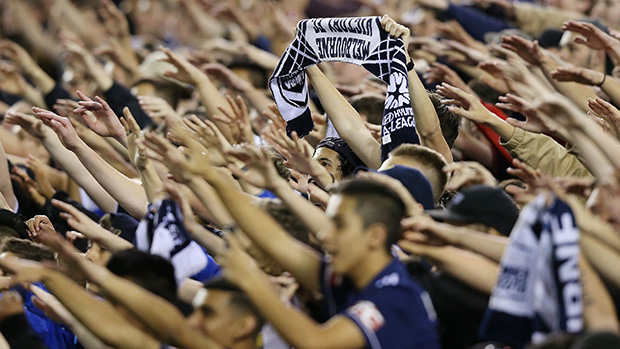
Victory fans having fun. Pic: Getty.

Victory fans having fun. Pic: Getty.

I sat, not really caring, but happy to let the occasion flow over me; even chatting to an ex-Socceroo who happened to sit next to me. (My bluff of knowledge came to a crashing end when I had to confess I had no idea his son currently played in the EPL or for the Socceroos.)

Mostly, I watched the fans. Because they were seriously into it. My biggest immediate take-out was that it was a larger male crowd. I’m used to AFL crowds and AIHL crowds, and they are both heavily mixed gender. I feel like I can’t confidently say whether a Melbourne Ice or Mustangs crowd would be skewed more male than female. Likewise, AFL is probably not 50-50 but there are many women there, and passionate about the game.

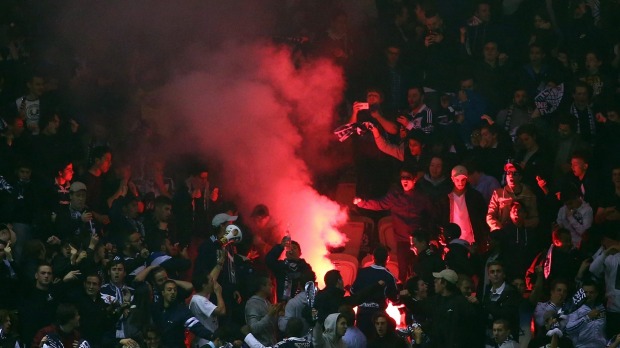
On a casual observation, the soccer crowd felt male – between 20 and 50 years old. And it was an occasion for these men to go nuts. There were the usual flares and horns and chants. As Victory took the ascendancy, an entire stand to my left was heaving with people dancing and chanting and waving. The atmosphere was fantastic, yet I felt totally removed, like I was at the zoo, watching from behind glass.

Soccer fans having fun.

Soccer fans doing their thing. I’m not judgmental: Red Wings fans like to throw octopi on the ice.

It got me thinking it’s so strange how some sports can grab your soul and others leave you totally cold. Like, cricket is polarizing in a love it or hate it manner, and so is American football.

I have watched and reported on and experienced and studied many sports over my 30 year journalistic career, aside from being an enthusiast, and I can say with certainty that I am resolutely unmoved by basketball, soccer and baseball. I never had much time for NRL and still don’t really, except that a couple of people who understand the game have explained subtleties to me that made it more interesting as I watched. I can stomach it now but I still wouldn’t pay for a ticket.

Rugby union, when it’s flowing and it’s an important game, like Australia in a World Cup, can be exciting. The characters and sheer danger of boxing, as well as the strategy and fitness, has always gripped me. Tennis lost me, largely, after I had to spend too much time around certain Australian prima donna tennis players, and after I had to watch too much of it as a reporter, and in places where the matches simply didn’t matter: a second round loss for a player just meant an earlier plane to the next city. When the stakes were Grand Slam high and somebody as good as Sampras, Graf or Federer was at their peak: then it got good.

But that’s just me. Whatever you’re into is fine. In fact, English Premier League soccer (and yes, I use the word soccer as an abbreviation of ‘Association Football’, especially because the Melbourne Football Club was formed before any of the English clubs, so screw you ‘world football’; okay, that’s another story) but EPL soccer is kind of like seafood for me. I don’t enjoy eating fish. Some of it I really dislike, while certain flavours of seafood I can tolerate. But when everybody around you is having a mouth orgasm because the food is so amazing, and you’re just ‘tolerating’ it, you feel guilty and wonder what is wrong with you? What are you missing, and why? I’m like that with the EPL competition. So many of my friends have EPL teams, follow it in the middle of the night, start work conversations with a quick discussion of last night’s results or pending big money transfers … and I have nothing to add.

It doesn’t mean I’m against it; not at all. A really great game of soccer can be fun to watch, especially if it’s attacking and end-to-end and the crowd is at fever pitch, but you know, shrug. The World Cup can be fun.

One of my mobs. Go Tigers!!! (you hopeless, underachieving bastards)

One of my mobs. Go Tigers!!! (you hopeless, underachieving bastards)

By contrast, Australian Rules has held me from before I can remember to now, when Richmond continues to be remorselessly shit, no matter what, and when I still run around, feeling the leather with a bunch of men old enough to know better who gather once or twice a week for the pure joy of landing a pass in the outstretched hands of a fellow player on the lead.

Hockey? Well, hockey grabbed me from the moment I turned on my television years ago now and saw my first Stanley Cup final game between Detroit and Pittsburgh and something in me stirred. Immediately. Grabbed me! Made my heart beat. Has seen me holding my head in my hands, screaming at Gamecenter as the Wings performed miracles or screwed up, soaring as the Ice achieved the three-peat of cups, slumping as the Ice lost last year’s grand final; even physically taking on such a crazy sport as an activity, having never skated.

All of that. All. Of. That.

Blood pumping. Passion burning. Feeling alive.

One of my other mobs: The Cup-winning Red Wings that captured my heart.

One of my other mobs: The Cup-winning Red Wings that captured my heart.

Which is why I found it so strange, so abstract, that I could watch those Victory fans last Friday night, screaming and yelling and jumping up and down and foaming at the mouth, and realised that I was just staring at them, completely unable to bridge the gap between us. The bridge of caring.

And I found myself wondering how many pieces of silverware are fought for across the globe, in how many individual sports and individual competitions within those sports, and by how many teams and cheered for by how many millions, whether from NFL to Brunswick trugo? Somebody everywhere willing to bulge at the jugular, to ride that scoreboard or that goal or that umpire’s decision; that bounce of a ball or a puck or a footy or a punch or a shot; the fans’ sporting existence living or dying on the fortunes of that moment in their chosen passion.

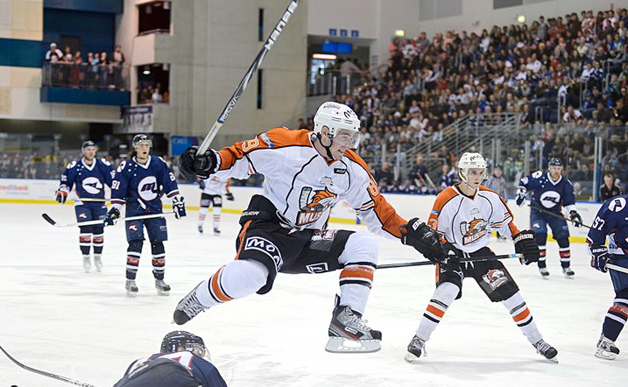
Ice v Mustangs at the Icehouse. Now we're talking ...

Ice v Mustangs at the Icehouse. Now we’re talking …

There’s no deep meaning to any of these observations. It’s totally okay. Those Melbourne Victory and City fans would probably stand on the glass, politely observing, when the Ice and Mustangs were going at one another’s throats, and be wistful that nobody is throwing flares.

Each to their own, I say, and go the winner in this weekend’s A-League grand final.

I wish those chanting, excitable hordes well.

I’ll just be watching the hockey and the Tigers. It’s what I do.


Guest blog: Author Will Brodie’s two hockey lives

WORLD EXCLUSIVE: Nicko writes: I met Will Brodie through mutual writing/journalism friends quite a few years ago, and before my hockey adventure began, so the fact that he’d played as a kid didn’t resonate with me at the time, as it does now. However, as he’s rediscovered his love of the sport, and played a vital role in getting media oxygen for the AIHL at The Age Online, and now through his excellent book, ‘Reality Check‘, it’s been fun to see him reestablish himself in our crazy world. A while ago, I invited hockey players to write for the blog and had a series of guest writer ‘origin stories’ as a result. That offer has always remained open (and remains open, for anybody who wants to tell their story). Will found time, between marketing and selling ‘Reality Check’, to tell his yarn. Here it is:

A tale of two hockey lives

By Will Brodie When I chatted to Nick Place about his hockey journey, he remarked that the experience of those who first played in the 1970s was unknown to many of those who have taken to the sport since the advent of the Icehouse. He suggested I write about my origins in hockey and what it was like back then, and I was keen to share reminiscences of a formative, fondly remembered era.

Will Brodie, centre, as a young Blackhawk in 1977. With his best mates, Glenn and Tim.

Will Brodie, centre, as a young Blackhawk in 1977. With his best mates, Glenn and Tim.

I have had two hockey lives. My first began when I was a young child in the early 1970s, when I used a sawn-off stick as I mucked about with mates including Glenn and Tim Grandy at our Dads’ senior Blackhawks practices early on Sunday mornings. When senior scrimmage took over the entire ice surface, we repaired to the worn floorboards of St Moritz to improvise endless games with pucks made from balled-up discarded stick tape (suspiciously like electrical tape in those days). If we bribed our fathers at the right moment we would get cokes in small bottles, a style revived decades later as a ‘retro’ marketing/packaging ploy. Later we all played together in the Blackhawks juniors, starting as 10-year-olds playing under-16s. When I was 14, playing a game of footy and two games of hockey each Sunday, I hurt a knee, perhaps inevitably. The initial niggle came in a way unique to rough rinks in those days – condensation or leakage from the roof dripping down and forming nasty little yellow stalagmites which rose off the ice surface. I skated over one, felt a twinge and a later tackle from behind in a footy game finished my cartilage off well enough for me to spend weeks on crutches. Living on the suburban/urban fringe, I had started attending school in the city and, when I recovered, the prospect of training at midnight Friday – with a merged team which included members of our previous arch-rivals – was not enough to bring me back. I never made a decision to never again play, merely not to play that year, then the usual adolescent distractions intervened and by the time I was into young adulthood, the five-rink league of my youth had shrunk to just Oakleigh. As I write in Reality Check: “I meant to get back to hockey but never did”.

All hail the 1977 junior Blackhawks.

All hail the 1977 junior Blackhawks.

This first age of hockey of mine was blessed by a golden age of rinks in Melbourne. Like visiting VFL home grounds, playing at Footscray, Ringwood, St Moritz and Oakleigh was exciting and fascinating, each rink possessing a unique atmosphere. Dandenong was a good size, but felt like the converted factory it was; St Moritz was a magnificent faded relic, all art deco timber, and all too vulnerable to a cynical match; Footscray was always wet and less scary than you thought it would be; Ringwood was like the MCG of the sport, housing the slick Rangers and home to the brief incursion of the sport on to ABC TV; Oakleigh was the tiny, combative rink where they played stirring American marching band anthems ahead of senior finals games.

The old Ringwood rink. Man, couldn't we use that now!

The old Ringwood rink, ‘The MCG of the sport’. Man, couldn’t we use that now!

We played the Monarchs, Pirates, Hakoah, Rangers … Many of the clubs familiar to players these days are unfamiliar to me. Jets? Sharks? They are long-established but they were the product of mergers or changes which came long after my playing career. When we weren’t playing, we were often forming a very small, shrill cheer squad for the seniors, banging on the hoardings at the Dandenong Coliseum. When I walk through the Icehouse’s St Moritz bar these days, many of the names on the trophies are those of friends of my Dad that we cheered for, friendly hockey types who held court at the backyard barbecues where Glenn and I played hockey with fallen lemons. My Dad and his hockey friends consistently lunched long on Fridays, bottled wine to raise funds for the club and the Australian national team and went on holidays with their families together. They eventually all bought a property together, in the glorious bush of the Victorian Great Dividing Range. I still camp on that property with my family. Old hockey sticks were redeployed alongside our tents as prospective ‘bong-bong’ sticks in case errant snakes strayed too close to habitation. My brother still has a relic of one of those sticks, a shrunken red Titan. To me, Titan sticks were the fancy newcomer – I had grown up accustomed to KOHO and Sherwood, but such is the foreshadowing of memory; Titans were probably around for most of my childhood. The first impressions remain the strongest.

Hockey as Will Brodie used to know it: The 1977 Australian team that played West Germany.

Hockey as Will Brodie used to know it: The 1977 Australian team that played West Germany.

My second hockey life began in 2010 when my brother Craig took me to a game at the recently opened Icehouse. I fell back in love with the game instantly, amazed at the venue – the seemingly grandiose, unrealistic dream of decades previous made real – and the remarkable crowds, but mostly just the game itself, better than it had ever been played in Australia, and presented so much more ‘professionally’, with music and announcers. My hockey renaissance via the Icehouse came at around the same time Nick and so many others were taking their newfound enthusiasm to the next level by buying skates, taking lessons and learning how to play. Nick is a wholehearted sort of hockey lover – he had to play, not just watch. For those of us who have played but been away for a long time – the itch to play again never goes away. There is nothing like playing hockey. If you don’t play for a long time, it seeps into your dreams. I had my first skate in 30 years in mid 2012 and did my (other) knee (on terra firma) a week later. I don’t drive, I am not wealthy and my lower limbs are faulty – returning to playing hockey is not an easy choice to make at 48, especially when I have such vivid memories of being a competent junior. But the more I watched, the closer I got to the players and the ice surfaces by writing my book about the AIHL in 2014, the more the hockey dreams returned. The smell of sweat in the cold. The smell of lacerated rubber matting, decades old. The clacking sound of sticks, skates, pucks, boards. It is little wonder that the subconscious is activated by hockey – while one is sleeping, the most affecting sensations have their run of the mind and soul. Asleep, there is no rational mind saying ‘you’re too old/hurt/poor to play again’. My hockey dreams bring back very specific moments and sensations. I remember the jelly-legged fear and excitement when pulling up at a foreign rink ahead of a game. I remember the intoxicating odour drift of exhaust in the pre-dawn fog at Sunday morning practices as a diesel-powered tractor with chains on its tyres trudged up and down to clean the ice. The same tractors I would see in the fields near our camping getaway; Massey Fergusons rolled through my childhood like pets. I remember the forbidding holes at the corners of some rinks where snow was shoved down by flat, wide person-powered shovels. The red digital scoreboards which glowed either warmly or tauntingly depending on the numbers they exhibited.

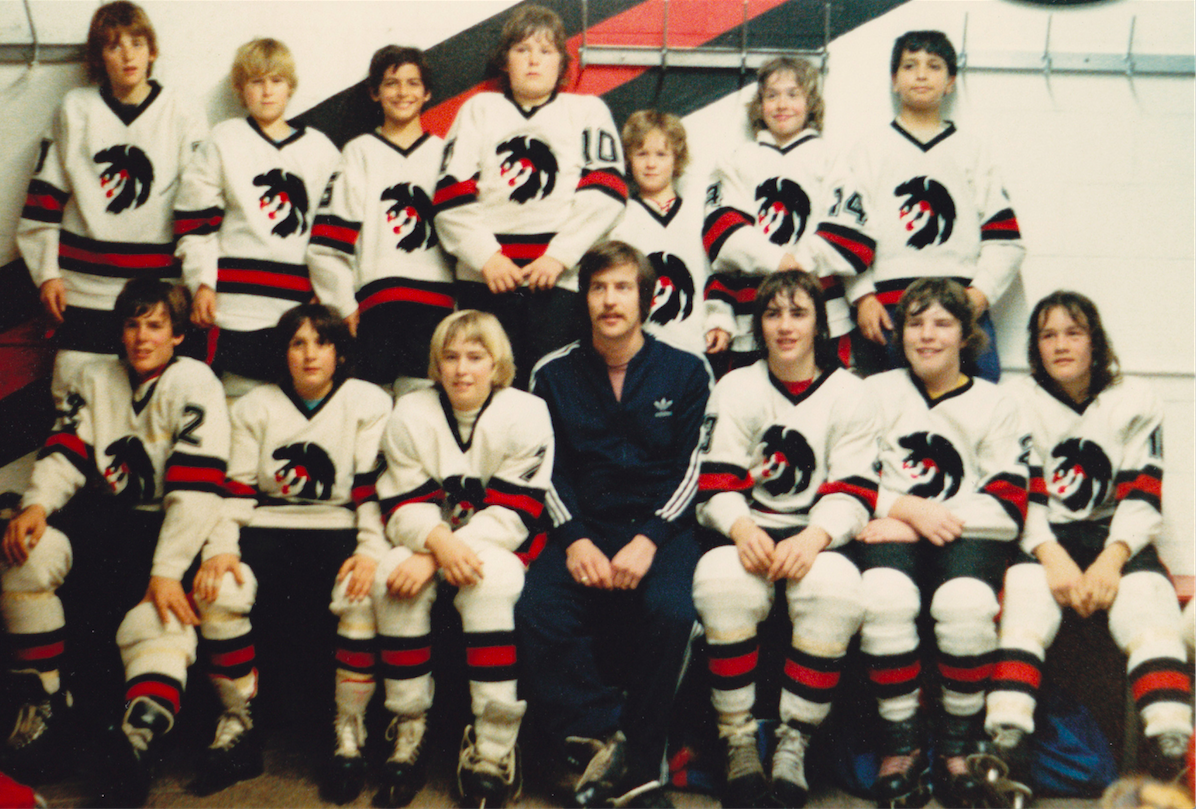
1980 Blackhawks, featuring Will Brodie. You can tell they're hockey players because nobody is looking at the right camera.

1980 Blackhawks, featuring Will Brodie. You can tell they’re hockey players because nobody is looking at the right camera.

I recall the completion of pulling a jersey over your gear before a game, and suddenly being transformed into a player; the perfect satisfaction of a pass setting up a goal-scoring mate; the oxygenated agony of stops and starts; the post-practice glow, with all of Sunday still stretching ahead; ignominious losses that taught me that teams beat talent; the sensation of gliding a circle after having hustled for speed; the sensation of beating a goalie, sometimes a mystery worthy of In Search Of investigation, sometimes as simple as just being there in the slot. The game gets brutal at about the point I left it as a teenager – the need for elite physical conditioning and mental and physical toughness kicks in and angsty veins pump anger around the rinks. I may not have been tough enough to go far in hockey, and I was certainly not a good enough skater to end up playing for Australia like Glenn did. But if I had learned how to handle myself, I would have enjoyed that rush and slide of hockey for a lot longer. Truth is, when the game shrank to just Oakleigh, it took rare dedication to keep rocking up, travelling long distances, putting up with yet another year of the cold. You had to be a complete hockey tragic, and thank god there were enough of those wonderful beasts to keep the sport going. And thank god for the Icehouse, which gave the softer hockey lovers like me somewhere to reignite our passion for the game. If I was to play again, I would want to start by marching from Huntingdale station to brave frigid old Oakleigh. For the first time with a stick in my hands at least, I would have to reconnect with the rough charms of my childhood hockey, where everything is reduced to your skates, your stick, the ice and your teammates. Then I would accept the luxury of the Icehouse without shame, and maybe pull some strings to get them to put on that John Phillip Sousa marching music so I could imagine I was about to play a senior final. * * * * * * * * * * * * * * * * * * * * * THE PLUG: Will Brodie’s new book, Reality Check, is a personal account of following the Melbourne Mustangs and the Melbourne Ice through the 2014 AIHL season. Will went on all the road trips with the teams and hung out behind the scenes at the Icehouse. It’s a beautifully crafted and fascinating account of an exciting year in the AIHL, and the players, coaches and volunteers who make hockey happen in this country. I fully recommend it, and not just because Will is a mate. It’s a cracking read! CLICK HERE TO PURCHASE REALITY CHECK.

Becoming what you might have been.

‘It’s never too late to be what you might have been.’

I love that truism, even if it works better in some contexts than others. This week, for example, has been a pretty stern test for George Eliot’s quote, and also a stark example of the difference between sport and life.

Andrew Chan and Myuran Sukumaran used their entire 10 years in a Bali prison to try to become the men they might have been, had they not been dickhead enough to try and smuggle heroin in their early 20s. They seem to have succeeded, except for the fact that a dick-swinging Indonesian president, elected on a hardline agenda when it comes to his country’s drug problem, decided the two Australians’ lives were better used as collateral that could deliver popularity, instead of recognising their work to become better people.

As has been endlessly reported, Chan used his time in jail to explore Faith, and devoted himself to making other prisoners’ lives better in his finite time left on Earth. Sukumaran painted, expressed himself, laughed a lot, and reportedly evolved into an intelligent, gentle giant, to the point that the act of shooting him in the heart most definitely felt like murder rather than justice.

In the end, Eliot was wrong: they could not out-run that one massive mistake of their youth but, by the time it fatally caught up with them, they at least were able to stand tall, somehow seen by the wider community as more inspirational than dirty drug mules. (And none of this is to suggest that their original crime was okay: I am vehemently anti hard drugs and the people who would bring them into Australia. I just acknowledge the criminals’ rehabilitation.)

Of course, there’s not much of a link between that whole sorry business and hockey, and especially this now-half-century-old Melbourne struggler.

Except that those horrific events underline, strongly, how much easier sport is, even when it goes badly, compared to real life. Context can be useful sometimes, when we think the sporting Gods are against us. Hockey and other sports are not actually life-and-death, no matter how energetically some commentators may try to put that spin on it. I was encouraged to see several AFL footballers actively dismissing all the ANZAC Day bullshit that likes to make out that football is war. A couple of players went out of their way, in interviews, to underline that they understand and appreciate the difference; that they’re only playing sport, not facing the unimaginable horrors that soldiers, Turk or Australian, New Zealander or British, did at Gallipoli.

Tiger Nathan Drummond buckles his knee in his first game. Pic AFL Media

Tiger Nathan Drummond buckles his knee in his first game. Pic AFL Media

Yes, a promising young Tiger, Nathan Drummond, made his debut for the club last Friday night against Melbourne only to collapse, in agony, clutching his knee, and duly needed season-ending surgery. That sucks dog balls, as an ex-girlfriend of mine liked to say, but Drummond can come back and try again. He gets to do rehab, and sweat and grit his teeth, and overcome this hurdle.

Even as I watched my ever-frustrating Tigers fail to turn up against a young and committed Demon team that night, falling with depressing meekness in the rain, I could be comfortable in the knowledge that Richmond would get another shot at being the finals-bound team it was resolutely failing to be, this weekend at the MCG versus Geelong. That morning, I had already watched my beloved Red Wings, in the first-round of the NHL play-offs, against Tampa Bay, carry a 2-0 lead deep into the third period, all set to go 3-1 up in the series, only to drop three goals in eight minutes to lose and re-earn their underdog status.

It only took them two days to rediscover the team they might have been, winning big in Tampa Bay, before returning to the Joe and losing again. And so, as I type this, it’s 0-0 at the end of the first period of Game 7 at Tampa Bay, and the Wings may or may not be going through to the second round.

Which will lead to whether Mike Babcock will or won’t remain as head coach next year, as he comes off contract and fields huge offers from a range of teams desperate for him to take over their franchises.

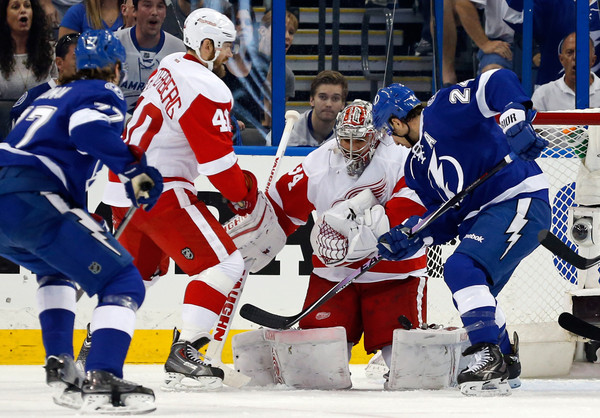
Detroit and Tampa Bay battle it out in the NHL play-offs.

Detroit and Tampa Bay battle it out in the NHL play-offs.

And, if the team has lost today, players will come and go and the team will seek to improve beyond the once-mighty power that hasn’t made it past the first couple of rounds of play-offs for years now. The longest active play-off streak in American sport – 24 years and counting – doesn’t mean much when you get KOed straight away every time.

But, to emphasise, Eliot’s point, they get another shot. Every season. And if Babcock does leave, somebody else will take that chair and the team will evolve in a new direction.

Me? Right now, I feel a long way from the hockey player I might have been, or even am. I’m carrying a nasty head cold and I haven’t written any blogs because I’ve had a month off the ice, getting busy with swapping rings, working hard in two jobs, turning 50, entertaining family from France, doing pretty much anything except regular fitness work. Like everybody, I feel in my head that I am much younger than my chronological age, but I think the one part of hitting my half-century that I’m aware of is that if I stop moving, my body starts to immediately lose its edge. Like a shark that must swim to not drown, I simply can’t take a month off any more without noticing it, and so I’m resting only for as long as it takes to see off this virus and then I simply have to get back on the ice, get back in the gym, ride my awesome new mountain bike and do all the things I usually do to be fit and ready for next summer’s Div 3 action.

The good news is that I have that chance, I have the blessed life that I have, to evolve and explore and see what I can still be in the second half of my life. Hopefully better than I am and I have been.

Chan and Sukumaran, and the six men executed with them, don’t have that chance. But if you’re reading this, you do. Live large, people. Take a moment to breathe, to enjoy the feeling of simply being alive. And then get on with things.


The end of another summer?

Tonight, I potentially play my last game of the IHV Div 3 2014/15 summer season. My team, the Cherokees, has a game next weekend to finish the regular season but I have a wedding I can’t miss and so tonight, at 10.30 pm at the Icehouse against the Champs, is it for me. Except that we’re going to win tonight and therefore play finals in a couple of weeks, but that’s for another blog.

As always, as the end of the official season approaches, I feel melancholy. There are aspects of being in a team, of sharing adventures with the same group of people, that are impossible to capture elsewhere. It’s something I cherish because I only watched it from the outside for so many years as a sports journalist while, as a kid, I was more of a surfer than a footy player and only played indoor cricket with some mates for fun. The Bang, my winter footy world with a bunch of similarly creaky Sherrin-chasers, goes close but we don’t have actual matches, we don’t skate onto the Henke Rink needing to win to make the finals. That sort of adrenalin is hard to bottle.

I haven’t written the blog since returning from Christmas because there hasn’t been much to write about, in a hockey sense. I’ve been training on Wednesdays, very much as per the final blog of last year, where Tommy, Lliam, Army and Shona own our arses in dev league after we complete drills in Inter class. We’ve played some Cherokee games and continue to get more cohesive and dangerous as a team, just as we’re going to have to stop.

In my happy place (pun intended): playing the goon for the Cherokees.

In my happy place (pun intended): playing the goon for the Cherokees.

Away from the rink, I’ve been on an intense fitness campaign – including a non-negotiable minimum of 50 push-ups and 100 sit-ups per day, over and above hockey training, gym workouts and other fitness – and feel great for it. It’s kind of annoying that I feel like I’m hitting peak fitness at the exact moment I’m about to stop playing competitive hockey.

On Monday, I even walked to work, and therefore found myself wandering past the Punt Road Oval just as my beloved Richmond footy team was warming up for training. Somebody had left a gate open and that’s all a former journo needs to sneak in and take a seat … I eventually made myself useful by collecting the balls that were kicked too high for the epic netting behind the goals (about one in five shots), so that I felt like a little kid again, scurrying around behind the goals at the school end of Lorne’s Stribling Reserve to get the footy as the Lorne Dolphins took on their Otway opponents, surf booming from down the hill.

But I digress. It was fascinating watching the Tigers go through their routines. It’s a long time since I’ve been to an AFL training session. As a journo, I hung out at training all the time and mostly took it for granted but now I saw it all through fresh eyes. The Tigers warm up using many of the time-honoured techniques all footy teams do, such as two players sharing one ball, playing kick-to-kick from 20 metres apart. Even us Bangers do that before starting to run around, but Richmond puts a little spin on it: instead of standing, flat footed, to mark the ball, then kick it back, the Tigers mark it, turn, take four or five steps backwards, then pivot and deliver the pass back to their mate. It’s recreating the movement of taking a grab, and then retreating from somebody standing on the mark, to turn and bullet a pass to a teammate. Kicking with one foot and then the other. Even before their hammies are vaguely warmed up, they’re recreating match conditions.

They weren’t finished. After a while, the players took to marking the ball, then dropping it and letting it bounce on the ground a couple of times before they bent, picked it up and kicked before straightening. Again, in a match, you don’t have time to scoop up the ball, stand straight, balance, look around and then kick. So at training, they’re kicking from a half-crouch, having snared the ball on a half volley.

Jack Riewoldt shows his style at training.

Jack Riewoldt shows his style at training.

Everything had a meaning; everything had purpose. When a coach called ‘drink break’, the Tigers ran back to their drink bottles as fast as they possibly could. I mean: sprinted! It was like there was a thousand bucks cash on the boundary near their bottles. In a game, you don’t jog back to the bench, you get the fuck off the playing surface so your replacement can get on. One player yelled: ‘This is not a drill, peoples. This is not a footy drill!’ just to be a goose, but that’s where I started to see the correlations between what they were doing and hockey training. Sprinting to the boundary, for example, has direct application for hockey. If you’ve ever played in a team with somebody who dawdles back to the bench, stick in the air, because that’s how they’ve seen the NHL players do it … while you’re watching your team now a man down on an opposition breakaway, you’ll know what I mean. If you’re going to end your shift, skate hard to the boards, peoples.

At our training, the coaches endless ask us to skate fast over to the whiteboard so they can explain the next drill, but people saunter back, grab a drink, gradually tune in. The Tigers, professional athletes, are there, drinking, in a flash, and then on their way to the next activity with intent. Impressive intent.

The other drill that caught my eye was when they started doing run-throughs. Six or seven Tigers would leave one end of the ground at a time, running at maybe 60-70 per cent. As they approached the cones 150 metres away, a coach would be standing with a Sherrin in his hands. He would fire a handball to one of the running players, but they didn’t know which until he suddenly rocketed the ball to them. Lightning fast hands snared the ball in one grab every time. In hockey, a lot of our drills are choreographed, as in ‘Man A leaves this corner, skates around this cone, looks for a pass from Man B who then skates to here to receive the pass back before the blue line’. The Tigers add a little matchday randomness to everything, because in a game, you don’t have the choreographed puck arrive just as you’re ready for it after rounding a cone. In fact, hockey games and AFL games are very much about making snap decisions and of having the puck or ball arrive sometimes unexpectedly.

This is not to say footy training is better/smarter than what we do at the Icehouse. I fully get that hockey skill drills are a different beast to the Tigers’ match day recreation stuff and that we hockey rookies need to have drilled into us over and over again how to break-out, how to form a three man rush, how to pass in front of a skater, not to their feet … these are basics that we need to keep working on but the Tigers don’t exactly have to worry about. And anyway, at the Bang, one of our elders, a well-known singer songwriter, is forever trying to get us to do a three-man handball weave as we run warm-up laps, but it’s laughable how incompetent we all are at such a basic move. It drives him insane. Sometimes, hockey players and footy players are better when acting by instinct, instead of trying to handball to here, move from point A to point B, receive the ball there, move from Point B to Point C.

And then, anyway, the Tigers surprised me and made me laugh, by doing a drill that was so robotic and synchronized that it looked like a line-dance.

The whole thing was fun to watch, and scamper around, collecting footys. I walked the rest of the way to work and back to my real life, looking forward to the AFL season starting, so that the Tigers can prove they’re finally the real thing. The calendar clicking ever closer to footy mode also means the Melbourne Ice women will have secured the title by then, which means the Melbourne Ice men will be ready to show the Giddyup Clippy Clop Orange crowd that last year’s final was just a bad day on the wrong day.

Me? I’ll be spending Wednesday nights on the ice with Big Cat, and Sundays at the Bang with my footy brothers, occasionally, hopefully, scuba diving with Mackquist, and all the time wondering if my creaky old body has another summer of competitive hockey left in it? As I do every year. Before I inevitably sign up and pull the Cherokees No. 17 jersey over my shoulder pads, chasing that locker-room brother-and-sisterhood that I adore and the sheer thrill of the battle. I love it all. There’s life in the old dog yet.

Ho Ho Ho Homiliation!

The player skates fast, flying on edges, behind my net and I move to block the space where he has to come out. He flicks the puck straight over my stick, catches it and then taps it between my legs. As I try to process this, which has happened inside less than a second, he’s gone, like smoke into a flame, and by the time I turn around he’s skating through the blue line.

‘Goddamn it, Army,’ I call when I’ve skated to a point where I can yell at him. ‘You could at least try to pretend like that was difficult.’

Lliam Webster moving at maybe 50 per cent capacity during the coach scrimmage. Pic: Nicko

Lliam Webster moving at maybe 50 per cent capacity during the coach scrimmage. Pic: Nicko

Matt Armstrong, Melbourne Ice star, Canadian and former European pro, just laughs and apes my habitual legs-too-far-apart stance and cruises effortlessly away, faster than my fastest skating. I cuss quietly to myself and go chase the puck, because now Shona, captain of Melbourne Ice and Australia, is streaming through the middle and I know a pass will be coming if I can get to the right spot.

The final night of Hockey Academy at the Icehouse is always a lot of fun. Our coaches throw away any pretense of teaching – apart from schooling us in real time on the ice – and jump onto the ice for a scrimmage.

It’s actually not humiliating at all – I just really wanted to use that headline. It’s a night of miracles and wonder, although not in the Paul Simon kind of way. It’s a night where you can battle your way to the far goalpost and pretty much know that Tommy Powell (Australia and Melbourne Ice) will somehow weave the puck through eight legs and four sticks and a goalie, to land it right on your tape for the tap-in goal. It’s a night where Lliam Webster (captain, Melbourne Ice and Australia) will calmly stick-handle for what seems like an eternity, all within half a metre of his body, as hockey students flail and fail to steal the puck. It’s a night where goalies have nightmares, watching giant Melbourne Ice defender Todd Graham wind up from the blue line or watching Matt Armstrong come swinging in, deeking and curving, all angles and power, winding up and then last-second passing off to a player they hadn’t noticed to their left who has an open net. Or where Shona will just skate alongside a player, gently separating him or her from the puck without them quite realising until it’s too late.

It’s so much fun. And it reminds you how good the best actually are.

I’ve been really lucky to experience this moment across several sports, from my time as a sports writer. I once drove laps of a raceway with Bathurst veteran Jim Richards in his Targa Rally 4WD Porsche. It had rained – real Queensland rain – for an entire day beforehand and the track, on the outskirts of Brisbane, was underwater. Richards drove at roughly 200 kph around wide corners and faster down the straight, hurtling past smaller, hard-revving cars before jamming the brakes, screw the weather, to take a sharp right hander. Then flooring it, going through gears back to 200 or so. While doing this, casually chatting with me – I was surprised how easily we could hold a conversation given the screaming engine and the fact we were both wearing race helmets.

shona coach scrimmage‘So, what do you think?’ he asked me, looking across to the passenger seat and grinning as the car sliced impossibly fast through water and revs and blurred landscape.

‘You’ve got the best fucking job in the world,’ I said, meaning it, and he laughed, shoulders shaking, even as his hands and legs worked the car down through gears and brakes for a corner coming up, like, NOW.

People asked me later if I was scared but I wasn’t at all. In fact, what struck me more than anything was that this was Richards driving at a sponsor open day, giving supporters (and one feature writer) laps in the car. He was probably driving at 70 per cent of capacity, not about to push the car anywhere near its limits with passengers alongside. The speed and torque and thrill weren’t even at maximum revs, which had me wondering what it must be like when he really turns it on.

I had the same thought once in my tennis writing days. I can’t remember if I’ve written about this before but I used to play a lot of tennis and I hit possibly the best serve I can ever remember hitting in my life to Jason Stoltenberg, then a top player, at a Tennis Australia media open day. I decided, on a big point in a friendly doubles match, that there was no point playing for percentages. Stolts had been chirping me mercilessly as I bounced the balls at the baseline, preparing to serve, and so I wound up, swung from the ankles and somehow, against all the odds, absolutely creamed it. I swear I could not hit a tennis ball any better than that and my serve was the best part of my game. This one was aimed at the sideline of the backhand court and it hit the outside edge of that tramline, skidded off the paint and was gone, man, gone.

I barely had time to register the extent of how legendary I was, before a green blur passed my feet as it landed just inside the baseline and disappeared. Stolts had taken maybe half a step to his left and effortlessly backhanded the return past me before I finished my follow-through.

Lliam at full capacity during the coach scrimmage. Pic: Nicko

Lliam at full capacity during the coach scrimmage. Pic: Nicko

I couldn’t disguise how absolutely gutted I was (yes, my partner and I lost the set), and he almost died laughing, but later I told him it was instructive. Hanging out on the tennis tour, and hitting a few balls here and there, reporters would start to think it doesn’t look so hard, maybe with the right practice I could get out there and aim for Wimbledon … some even entered qualifying for the satellite tour, the lowest rung, and got found out quickly.

But Stolts’ almost-yawning return of my absolutely best ‘100 per cent can’t hit it better’ serve ensured I never had those delusions. (My dad was a genuinely competitive Australian tennis player and thought about going on the world tour when it was ‘shamateur’, but then one day he had to return serve to Neale Fraser at training and Fraser broke 13 strings on dad’s racquet. Dad became an engineer.)

It runs through all sports: think how bloody good at football all those kids who don‘t get drafted into the AFL are. Think how impossibly good Test batsmen are, or bowlers.

So last night, I was there again, being reminded of just how impossibly vast the gap is between those at the top and us everyday mortals. And this is with Tommy, Lliam, Army, Todd and Shone operating at maybe 50 per cent capacity if we students were lucky. And without taking anything away from our coaches, it needs to be remembered that there are then clear levels above them before you get to the rarified air of the AHL and elite Canadian or European leagues, not to mention the NHL. Just how fucking good must Pavel Datsyuk be? Or a younger Wings lesser light like, say, Tomas Jurco, for that matter? Not that either of them are scoring any goals just now, but that’s another story.

Dev League has had a very high standard this term. It’s full of winter players keeping sharp and summer Div 2 players, which means they can play. But the coaches last night made everybody look like P-platers without really breaking a sweat. Not bothering with much armour, getting a puck back if they lost it, just having fun as we worked as hard as we could.

At one point in Dev, Tommy drifted past me as we all set up for a face-off in our defensive end. He said: ‘When the puck drops, just go.’

He nodded towards our goal at the other end. ‘Go.’

As left wing, I huddled over my stick as usual and as Lliam, as ref, dropped the puck, I did as instructed and took off. Didn’t even see who won the face-off. Just skated.

Sure enough, out of the sky comes a puck. Tommy had got it, as he knew he would, and lobbed it high into the air from deep in defence to the red line, the puck landing about a metre in front of me and dying as it bounced so that I could scoop it with my stick and charge the goalie. I have no idea how far behind me the White team opponents were but it felt like I had three quarters of the ice to myself. Of course, I overthought it and tried to go high and the goalie got a glove on it to stop the goal. Dammit. But what a move by Tommy.

Imagine being able to do that. Imagine being able to be like Army who tossed the puck from behind the net over the goal frame and into the goalie’s back and then the goal. Imagine being able to be Shona, not bothering with armour, as she sweeps the puck even off the Melbourne Ice men, turns on the burners and then stick-handles for as long as she needs to before one of us eventually arrives for a pass and maybe even a shot.

Or Lliam who seems to love the crazy stick-handling as mentioned and then the blind pass or the skate-kick pass.

We all struggle to keep up, occasionally feel our hearts soar if we actually manage to poke-check a puck away from one of the coaches, and enjoy receiving their silky passes.

It always means it’s the end of term when we have these games. This time, it’s the end of another hockey year. Every year ticking over gets closer to when playing competitive hockey will get beyond me and so I tend to get melancholy as I drive home through the night. Big Cat wasn’t there tonight either, which felt weird, but I love the hockey community so much that there were endless people to chat with and laugh with and commiserate with after another coach had skated around them, barely breaking a sweat.

After such a shitty week for everybody, with the Sydney siege by that mentally ill crackpot, it was beautiful to be out on the ice, eyes and mind for nothing but the puck. I missed a lot of sweet coach-delivered chances, but I also buried a couple, so it was a good night for me.

Now the skates are drying and my gear is hanging for the final time this year, I’d imagine.

Roll on 2015 and whatever the next hockey adventures are going to be. I can’t wait.

Have a great Christmas and see you all in new year. Let’s Go Red Wings.

Alter egos.

I turned up for work today in what Cassius, our six-year-old, calls ‘a handsome dress’, which is Cassius-speak for a suit and tie.

Less than 12 hours ago, I was wearing my hockey armour, flailing around on the Henke Rink as my dev league team got smashed in the second last go-around of the year.

Next Wednesday will be an even more dramatic change-of-gear (literally) as I have to somehow not drink (much) at a State Library Christmas party before heading to the Icehouse rink for the final Intermediate and Dev classes of 2014. Straight from Christmas formal wear to armour and skates. Can’t wait. I might even see if I can leave my smelly giant hockey bag in the foyer to really make people do double-takes.

One way by day ...

One way by day …

Of course, we’re all living this crazy double life. One thing by day, another by night (or wait, was that Princess Fiona in Shrek? Yes, I think it was).

In my time in hockey (coming up on five years), I’ve played on teams with political advisers, rocket scientists, musicians, an air conditioning repairman, cops, surveyers, lawyers, a doctor (well, he actually never turns up for my team, so I’m not sure I should count him), a video game architect, an editor, nurses, teachers, an alcohol salesman (clearly one of my better friends), engineers, a crazy R&D genius, computer programmers, developers, a landscape gardener, a mad chef, a priest and so many more.

In fact, to write this blog, I asked a Facebook hockey group what people did for jobs away from hockey? In no particular order, hockey players replied:
Electrician, surveyer, project manager, warehouse manager (alcohol – another friend!), engineer, IT managing director, events and communications for a not-for-profit, client relations – finance, NHL professional (sure, Will Ong, sure – I actually have that on my LinkedIn profile. Not much sense of humour on LinkedIn, I’ve since discovered), chief executive officer, IT guy, IT architect, IT analyst, techer/musician/retail manager, admin officer, mechanic (in fact, wind tunnel technician) (!!), myotherapist, sales, senior systems admin, teacher, occupational health and safety manager, IT network engineer, arborist, builder, graphic designer, landscape designer, another electrician, financial planner, logistics manager, unemployed, haematology clinical trial corordinator, hospitality, financial planner, AV technical director, media and journalism student/dental nurse, political and economic researcher/analyst for the Japanese Government (I can verify this – legit), cabinet maker, window cleaner, furniture upholsterer/cabinet maker, computer science student (with ambitions to be a pool boy in ‘one of those movies’), builder, documentation control officer working to be a sports therapist, pharmacy assistant, and finance and operations manager.

That was the response within an hour and, as was debated hotly on the thread, didn’t take into account all the ‘tradies’ who probably aren’t on Facebook at 10 am because they’re actually busy working and stuff … so we can safely throw a bunch of tradies onto that list, guaranteed.

FRIDAY UPDATE: Add to that list: IT, developer, sparkie, sparkie, metal tradie, baker, software engineer, arbourist, air traffic control (Pushing Tin – one of my favourite movies) , brain surgeon, student, lollishop worker, home duties (aka looking after kids), logistics, ‘pro gamer and porn star’ (AKA: the goalie is unemployed, mostly), accountant, public servant, clinical researcher making sure drugs are safe for use (assuming legal drugs here but this is Renee, so…), sparkie, teacher, forklift operator/storeman/shitkicker, cabinet making DJ, concreter, draftsman, physiotherapist, retail therapist, environmental engineer, financial controller, illegitimate businessman (by which Ray means: painter – finest ute in hockey by the way), more IT, business banker, more sparkies, nurse, hand model (made me laugh, Matthew – Seinfeld reference, or Zoolander, or both?),  ‘Build live size animatronic creatures like dinosaurs and dragons. For real(Nerissa Box may win the whole enchilada for that job), mental health worker and IT software developer. Phew.

AAAAAAND, BACK TO THE BLOG:
How cool is that list? I’m sure all hockey players know the moment where you tell people about your sport/passion and get the response: ‘Oh, isn’t that a violent sport for meatheads?’

... another by night.

… another by night.

It’s so not the case. Personally, I think nothing looks hotter than a woman dressed in full executive kit and high heels, carrying a giant hockey bag and sticks along Pearl River Road to the Icehouse. And it’s always entertaining when a player shows up in suit and tie, then yanks all that off to drag chest and elbow guards on. The list of occupations is so wildly diverse and interesting. And it explains why a hockey change-room is such a vibrant, fun place to hang out (except for after a 6-1 loss).

It also means that no matter what your need, from better wiring at your house to requiring an international spy to steal secrets from Luxembourg, you can probably tap into that skill set somewhere among the small but tight hockey community. I was talking to Lliam Webster who said he broke his arm badly, during a game at Oakleigh, as a 14-year-old and ended up at a local medical centre where they did a dubious job of fixing it, and so he ended up at the Royal Childrens where, lo and behold, a senior member of the Nite Owls (Sunday night and social comp ‘veterans’ hockey – see previous blogs) happened to be the main bone guy. Problem solved. Once in the hands of a hockey guy, all due care and consideration was taken and the teenager with the crooked mended bone is now captain of Melbourne Ice and Australia.

To me, this is part of the joy of hockey – that we come from all directions for the one love. Whether in the stands, cheering, or on the ice, skating, it’s a very multi-cultural, multi-class, multi-everything group of people.

I have my usual hockey hangover today, despite the unlikely suit and tie, and a big networking lunch this afternoon. But I know that all over town, others wearing whatever their daytime ‘alter ego’ disguise happens to be, are nursing similar hockey bags under their eyes. That rocks.

Let’s keep it as our little secret, here in this hockey outpost. The non-skaters never need to know.

The death of a cricketer

I’ve been hit in the helmet by a puck a few times. One that I remember really clanged into my temple: a warm-up slapshot by a teammate as I skated behind the net. I shook it off and laughed, as you do. Abused the relieved and apologetic teammate and skated on.

Because that’s what usually happens, isn’t it? Just as almost every lost skate-edge near the boards leads to nothing more than some bruises, usually to the ego. Just as every dangerously raised stick usually leads to no more than a clank and a grunt and some cursing and maybe a penalty if the refs are on their game. Possibly some blood if the player is wearing a visor instead of a cage. Just a flesh wound, as the Black Knight liked to say.

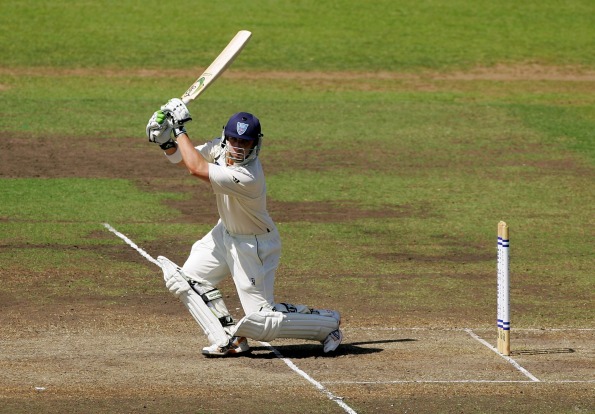
Phillip Hughes as I prefer to remember him. Batting with daring and style.

Phillip Hughes as I prefer to remember him. Batting with daring and style. Pic: Fairfax.

But every now and then the script runs differently. Sometimes sport goes as wrong as it possibly can. Australian cricketer Phillip Hughes died today, two days after being struck in the back of his skull by the hard red leather ball, trying to hook a bouncer and missing it. By the sort of bastard quirks of fate that are always involved in such horrific incidents, the ball somehow snuck under his helmet to directly hit his skull, fracturing it and cutting a major artery. Despite surgery and an induced coma, he never woke up.

What do we, hockey players in what we know can be a dangerous sport, take from a tragedy like this? Not a lot, to be honest. We just remind ourselves never to turn our back on the puck, as my coach sagely advised on Facebook a few minutes ago. We also fall back into the comfort of statistics: consider how many thousands and thousands of cricketers are playing the game every week around the world. One has fallen, when everything managed to line up to go as wrong as it could. Such a sports death is oh so genuinely tragic – a word that gets used way too much – but it’s an accident. Nothing more, nothing less.

Cricket, like hockey, can be dangerous and we can forget that. Then something like Phillip Hughes’ death brings that knowledge flooding back in a shock.

Our sport is no different. There are so so so so many hockey players skating around the rinks of the world, people. Amateurs, sub-professionals, NHL stars, learners, kids, enthusiasts, academy students, college players… the list goes on and on. Even in Australia, something like 20,000 players crowd onto our too-few rinks.

The reality is that some of those players will get hurt. That slightly awkward angle of a shoulder hitting boards that breaks bones instead of bouncing off. That puck that finds an unprotected side knee instead of the usual thick padding. Those tiny, random, impossible-to-plan-for moments. A goalie friend of mine tore his groin yesterday, making a save. He makes how many saves every week, every year? This one his body didn’t cope with, for whatever reason.

It will happen when we put ourselves at risk. Let’s face it, maybe a player will even get hit hard in the head, by the rubber puck. God, I hope not, and I feel genuinely ill at the idea of my son or my teammates being hurt. But there’s no way for us to plan or avoid that fraction of a second anyway, and the odds are that we’ll all be okay.

None of this, by the way, is to wave off Phillip Hughes’ death. Far from it. I feel heartsick at his demise: have been obsessed with worrying for his health since it happened. I don’t even know why: I’m nowhere near as into cricket as I used to be now that the NHL and my own hockey dominates my Australian summer. But I felt like I knew Hughes, from watching his brief spectacular and spluttering Test career and I liked the way he carried himself, his unusual cavalier batting style and the way he backed himself although small and slight. His death has hit me hard. Hell, maybe it’s simply because I am a parent? I ache for his family, and the poor paceman who bowled the ball that accidentally killed him.

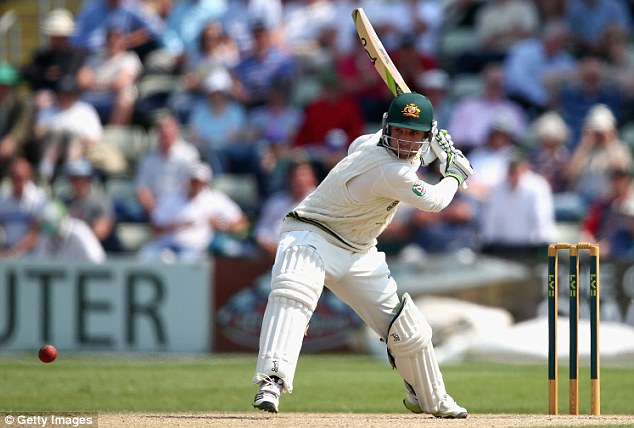
Phillip Hughes.

Phillip Hughes. Pic: Getty Images.

But for all of this sorrow, I’m trying to retain context, to retain poise. For anybody skating today, or playing this weekend, as we are against the Wolverines on Sunday, such context is important so that we can skate hard, throw ourselves into those crazy situations we usually do, and emerge smiling. Sport is 99 per cent healthy fun.

We humans can tend to look for ‘meaning’ in tragedy, to look for lessons or truths. As I’ve written before – especially after the equally tragic too-young off-ice death of a hockey mate, Charlie Srour, or the Russian plane crash that killed a former Red Wing and his entire team – I think the reality is that there is a lot of randomness in the universe and sometimes there is no sense, no reason why Hughes dies just short of his 26th birthday from a misjudged hook shot and Nick Place survives falling off a large cliff when I was 15 … it just is.

Blind shithouse luck, or a lack of it when it matters.

The Hockey Gods will mostly look after us skaters and, anyway, there’s no point dwelling on the fraction of a small chance that something might go wrong. If it does, it does. Enjoy your sport, as Phillip Hughes obviously did. Raise a glass for him as I plan to, shed a tear, and then strap on your skates. Go to where the puck will be, not where the puck is.

And I can’t tell you how much I mean it when I say: I hope you’ll be safe.

Surviving the hockey hangover

I’m glad my legs can’t talk, at least this morning.

‘You’re kidding, right?’

‘No f***ing way.’

I click my cleats into the pedals and the bike begins to roll, aching muscles protesting hard as they pull and push the pedals and I gain momentum. It’s only eight hours since I walked through the door of my apartment, post intermediate class and development league. Six hours, maybe, of fitful sleep. And now I’m riding across the inner city, which is mercifully flat, to work.

Suffering what we all know as the Hockey Hangover.

Thursday survival strategy: coffee.

Thursday survival strategy: coffee.

You know what I’m talking about.

This is a phenomenon familiar to pretty much anybody playing hockey, at least here in Melbourne. If you’re reading this in America, or Canada, or even Sydney with its handful of rinks, feel blessed.

We have two rinks for our city of 4.25 million people. Two.

In case you’re calculating, it works out at one rink per 2,125,000 residents.

There’s the palatial Icehouse at Docklands, and the slightly sub-palatial Olympic rink at Oakleigh.

The IHV summer comp has 25 teams across four divisions.

Plus the Melbourne Ice women’s team in mid-season.

Plus the Ice Academy, developing rookies and elite players..

Plus hockey school at the Icehouse.

Plus Nite Owls on Sundays.

Plus all the Next Level stuff and scrimmages at Oakleigh.

Plus winter players wanting ice time to keep their eye in.

Plus team training sessions.

This all equals a lot of teams and a lot of players. All wanting ice time. All wanting those two rinks. There are only so many hours in a day …

… you can see that some hockey players somewhere are having a late night. Every night.

My guaranteed late night is Wednesday, when development league steps off the ice at the not-so-bad hour of 11 pm. But it means at least a 1 am sleep time and on Thursday, that hurts.

I actually kind of like the late night cruise home from dev. It takes me back to my mis-spent youth as a police reporter for The Herald newspaper. A photographer and I would start work at 2 am, and sit in police headquarters, getting the nods, or cruise the empty streets, heading to murder scenes or fatal car accidents. Maybe a fire. Sometimes just driving to stay awake, police scanner static and rego checks in our ears. The whole city asleep, apart from this undercurrent, these ripples of evil, ripples of good, and somewhere the insomniacs staring into the dark.

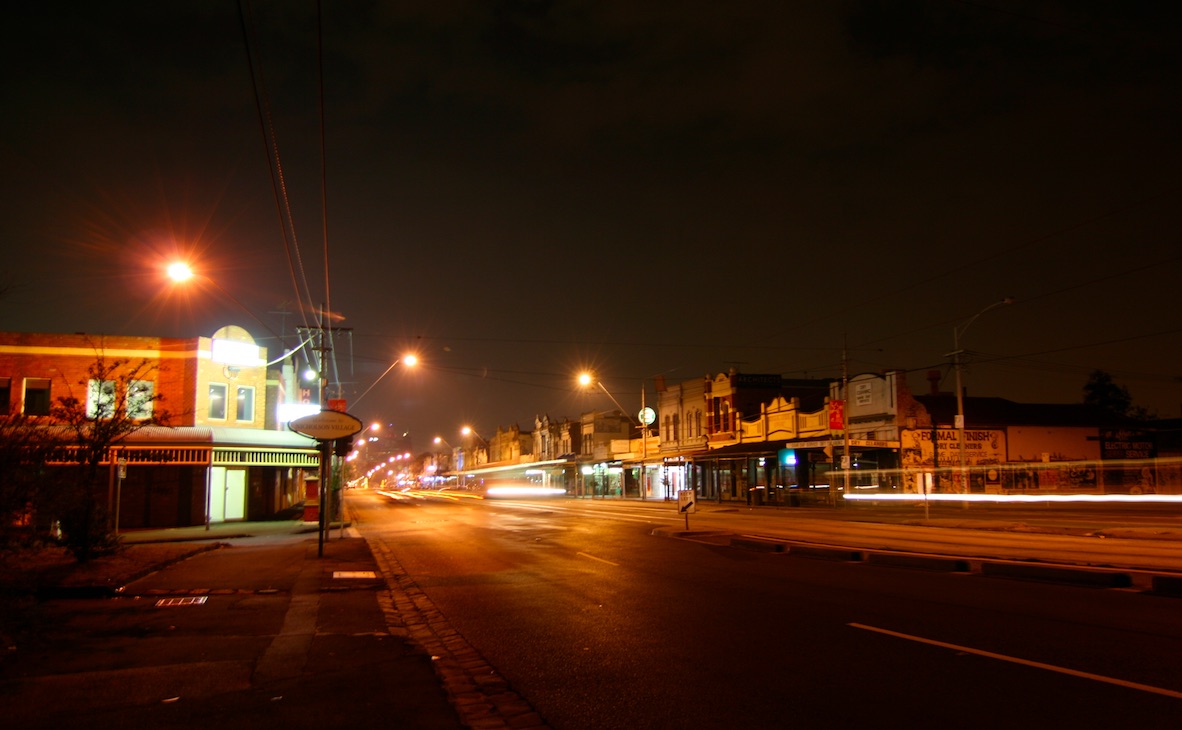
Late night in the hood. Empty streets, apart from shiftworkers, emergency workers, desperadoes and hockey players.

Late night in the hood. Empty streets, apart from shiftworkers, emergency workers, desperadoes and hockey players.

We’d cruise Lygon Street, grabbing 4 am coffees at all night cafes that I now know had illegal gambling happening upstairs; the downstairs wait staff eyeing us warily in case we were cops, not bleary-eyed journos.

Sometimes, post-crazy hour hockey feels like that. Last night, at 11.30 pm, Big Cat and I driving home, with music playing, discussing the game we’d just played (a 7-0 loss: ugly, yet four-on-four hockey all night: fun!)

As we turn into Brunswick Street, police blue and red lights are flashing towards the city. The street otherwise winding down with a few stragglers walking home or waving for taxis. In the open doors of a few cafes and bars, chairs are on tables, music playing as staff toil to clean up and get out of there.

Having dropped Big Cat off, I turn the car towards Fitzroy North, and click my iTunes over to ‘Breakfast at Sweethearts’, Cold Chisel’s mighty effort to capture that feeling of the end of a long, long night of work and/or play.

When I get home, the house is silent. My cat, Lady Byng, greets me with bumps. The dog is on a sleepover and so is not there tonight, no thumping wag of the tail from the top of the stairs to wake up Chloé, as I creep towards bed. But I’m wide awake, still wired. I spend an hour surfing the net, catching up on the Red Wings news, the Age, Guardian, New York Times, LA Times, and however many other reads I can manage before the adrenalin finally sags and my eyelids close.

And then, before I know it, there’s an alarm blaring and Oh God, seriously? Already?

I haven’t had nearly enough sleep, and my eyes look like baggy, bleary crap, but this is Thursday, every Thursday, and so I reach for caffeine and try to giddyup. My bike finds its way to work. My tired legs find their way to my office. My brain tries to kick in, and I drink more and more coffee and just want to curl up and sleep on the floor under my desk.

Like I said, we all know this feeling.

And it’s going to happen again next week. It’s going to happen the week after that.

Because what’s the alternative? Not play hockey?

Yeah, right.

Searching for a hockey God

I’ve never been a big fan of mixing religion and sport.

I’m not talking about the religious beliefs of my fellow hockey players. One of my former Jets teammates was pondering recently whether to even play summer competition this year because most of the games were on Saturdays, and that’s a religious down day for him – a devoted day to try and do good for the world, which is a nice idea.

I respect his dilemma, and admire his discipline. Quietly choosing belief over sport.

Instead I’m talking about the outspoken religious types on the wider stage. The athletes who use their moment in the spotlight to shove their God down everybody’s collective throat. You know, the Olympic sprinter who crosses herself after winning gold, looking to the Heavens. Or the golfer who earnestly thanks God for a PGA win, for Divinely helping that final three metre putt drop so the believer could bank the giant cheque. Meanwhile, in the world’s trouble spots …

My favourite and funniest ever example of this phenomenon was back in the carbon-dated era when I was a very young international tennis writer and an American teenager called Michael Chang won the French Open, the only time I ever got to cover Roland Garros. I was secretly sad that Chang won because one of my favourite players, Stefan Edberg, had played out of his brain to make the final and I think he knew and we knew and everybody knew that he would never get a chance like this again, to win the clay-based French title, the most difficult Grand Slam leg for his serve-volley talents, against some teenager.

Edberg was even up two sets to one in the final but couldn’t put away the dogged, mosquito-like Chang, finally losing, exhausted, 6-2 in the fifth.

All of which was fair enough – well played, kid – until the presentation ceremony. Chang’s victory speech went on and on, in a weary monologue about how God had won this title for him, that his success was all down to The Lord, that God had given him the strength and the legs, thank you God for this silverware, thank you God for this triumph … Seriously, it was cringeworthy.

Stefan Edberg (right) manages not to roll his eyes as Michael Chang drones on and on. Roland Garros, 1989.

Stefan Edberg (right) manages not to roll his eyes as Michael Chang drones on and on. Roland Garros, 1989.

Through all this, I was watching poor Edberg. The Swede is one of the nicest guys you would ever meet in world sport and he stood, absolutely poker-faced, through this endless rant. Finally, Chang wound it up and Edberg was able to leave the court and, in an unusual move, went straight to the media room. (On the world tennis tour, the loser is allowed to go second, for media, to give them time to compose themselves, especially after a Grand Slam final.)

The journalists gathered, respectfully quiet and sympathetic to Stefan’s loss. Edberg sipped water and sighed. There was the usual pause as everybody waited for somebody to pipe up with the opening question. And then an American journo said: ‘Stefan, why do you think God was so against you today?’

Oh, we laughed. Including Edberg, who did his quiet Swedish chortle and said: ‘No, no, no, no, no. I’m not touching that. No comment. Hahaha.’

And we all got back to discussing this backhand or that point and life returned to normal.

The only reason to bring this up – apart from the fact that this remains one of my favourite memories from my tennis writing days – is that Detroit played the Montreal Canadiens today, a team also known as the Habs or, in French Canada, as La Sainte-Flannelle (The Holy Flannel).

As far as hockey goes, religion usually seems to be about as present as in any other North American sport. You’ll get players thanking the Lord for their talent here or there, and I’m sure many players are deeply, privately religious.

For fans, there are the jokes (and I apologise in advance to religious friends reading this, if you find it offensive), such as:
‘Q: Why was Jesus terrible at hockey?
A: Because he kept getting nailed to the boards.’

You can buy the t-shirt ...

You can buy the t-shirt …

Or the bumper sticker: ‘Jesus saves. Passes to Noah, who shoots and scores!

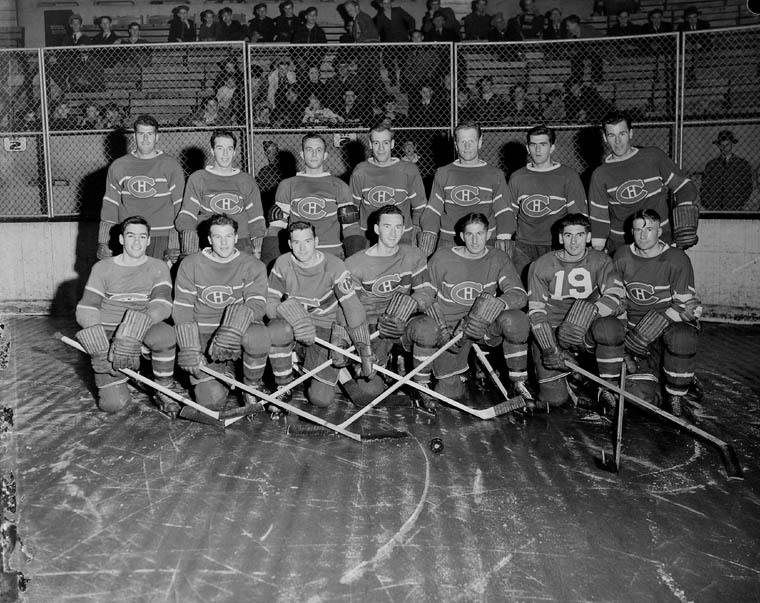
But the Canadiens shrug off such wisecracks to put an interesting spin on the whole question of sport and religion, because it has been seriously debated that the team may qualify as a faith.

In 2009, the centenary of the team’s creation, Professor Olivier Bauer at the Université de Montréal launched a 16 week class seriously asking the question: should the Canadiens should be regarded as a religion? It is unarguable that the team is much bigger to French-Canada than a mere sporting team. It is a cultural icon with a deeply powerful emotional attachment for its followers, to the point that Bauer raised the argument that the team was so deeply entwined to the region’s culture, spirit and self-belief that it may tick all the boxes required of a religion.

(The course, by the way, followed on from a book, co-edited by Bauer – who is unrelated to the hockey equipment company as far as I know – called La religion du Canadien de Montréal.)

In many ways, Montreal is to hockey what St Andrews in Scotland is to golf; the home, the foundation. For example, it was on March 3, 1875, that the first-ever indoor game of ice hockey was held there. Early incarnations of the Stanley Cup competition were won by the Montreal Hockey Club, the Montreal Victories, and then the Montreal Shamrocks, even before the Canadiens made real the idea of a unified, dedicated French-Canadian team, and later became the most dominant team in the competition.

The early days: ice hockey under a roof. Montreal, 1893.

The early days: ice hockey under a roof. Montreal, 1893.

There was always Catholic Church involvement in the Montreal Shamrocks and later the French-speaking Canadiens, until the Richard Riot, which followed all-time hero Maurice ‘Rocket’ Richard being thrown out of the 1955 season for punching a linesman. The street riot that followed transcended hockey and is pointed at by some as the start of the wider Quebec Quiet Revolution that eventually saw the region shake off the control of the Catholic church and English bank.

In his course, Professor Bauer argued only half-jokingly that if you look at the Canadiens’ followers all these years later, there is activity within the fan-base that could normally be ascribed to a religion. For example, fans committed to the team to such an extent that they were truly praying for victory. ‘The fans, they pray for two things. The first is that the Canadiens will win. The second thing is that they pray for the Canadiens to crush the Maple Leafs, but I think you don’t need any God for that,’ he added as an aside.

Bauer also discussed the concept that fans understood that sacrifice was required for glory.

‘You know, you have to suffer if you want to win. Jesus had to die and resurrect. That’s the kind of thing we expect from our players. You must be ready to suffer in order to win or earn us some victory. You must risk everything and sweat and fight or be knocked out,’ he said.

‘Charity has been the function of the church,’ he continued. ‘Now it’s the team who is taking charge of the social life, visiting children in hospitals, inviting children to see a game or giving money to charity… Does that mean they have kind of a religious role?’

Maurice 'Rocket' Richard's all-conquering and Quebec-changing Canadiens.

Maurice ‘Rocket’ Richard’s all-conquering and Quebec-changing Canadiens.

Finally, Bauer observed the blatantly religious parallels and iconography drawn by local media and fans. The old Montreal Forum was known as ‘the Cathedral of Hockey’. The team’s stars were often called names such as ‘St. Patrick’ Roy, and ‘Jesus Price’, instead of Carey Price. Back in the day, Richard’s unintended influence on the wider French-speaking Canadian world through his hockey exploits has been well documented. He became a symbol for Quebec as it rose to claim its true identity within the wider Canada – or Canadia, as Prime Minister Abbott might call it. In the excellent book of hockey essays, ‘Open Ice, a former Sports Illustrated writer, Jack Falla, vividly describes following an intangible urge to attend Richard’s funeral and how it was just, well, bigger than a hockey player’s farewell:
http://books.google.com.au/books?id=Eqsjm3zmtysC&lpg=PA11&ots=763CWYA6ij&dq=’open%20ice’%20book%20Richard%20funeral&pg=PA21&output=embed

In the end, Bauer’s course came the conclusion that the Canadiens could not be regarded as a religion because there was no supernatural element to the faith, an essential definer. And so, today, the Earth-bound Habs were just another NHL hockey team, continuing their excellent, non-spiritual early season form against the Wings, at the Joe, in their latest quest for an ever-elusive Stanley Cup; a Holy Grail that has refused to come home to Montreal since 1993.

As a hater of chest-beating religion in sport, I guess I’m okay with that. Maybe one day, the ghost of ‘Rocket’ Richard will be seen at the old cathedral, and  we can have this debate all over again. But until then, let’s push religion to where it belongs, away from the sports arena, and go chase pucks.