Preparing for a vintage summer

Summer hockey is serious business these days. With so many players flowing into the local sport and so few rinks (see several hundred previous posts on that topic) getting your first taste of competitive hockey is tricky.

My club, the Braves, had grading skates over the past two weekends. They weren’t so much try-out skates as working out in which division new Braves should play, with the idea that the teams should be evenly spread with talent and, most importantly, new skaters shouldn’t be blown away by experienced, more accomplished hockey players. As any reader of this blog will know, that remains one of my biggest issues in Ice Hockey Victoria competition – that too often there has been one or two players on a team in say Div 4 or Div 3 who simply shouldn’t be there, who should be playing several grades higher. Watching an opponent skate effortlessly around your entire team and then score top shelf, backhand, over their shoulder, while waving to the crowd, gets old after a while.

But it’s pretty much an honour system. These players are always there because they reportedly ‘want to play with their mates’, and I suppose I get that. I want to skate with my son, Big Cat Place, and then work things out from there. Happily I think we both fit the Div 3 profile without terrorising the opposition. In fact, I wish.

Being the dedicated professional hockey player that I am, I missed both the grading skates. I felt like Kevin Costner’s greatest ever character, ‘Crash’ Davis, in the Hall of Fame baseball film, Bull Durham, explaining that he doesn’t ‘try out’. (One of my favourite movie monologues ever.)

Actually, I had non-hockey alibis. In week one, I was at the world premiere of a friend’s film (Sucker, by one of my magic crowd mates, Lawrence Leung – I heartily recommend it: coming to cinemas soon) and then this weekend I was in Sydney, watching a legendary French dancer, Sylvie Guillem, take her final bows in Australia at the end of a glorious career.
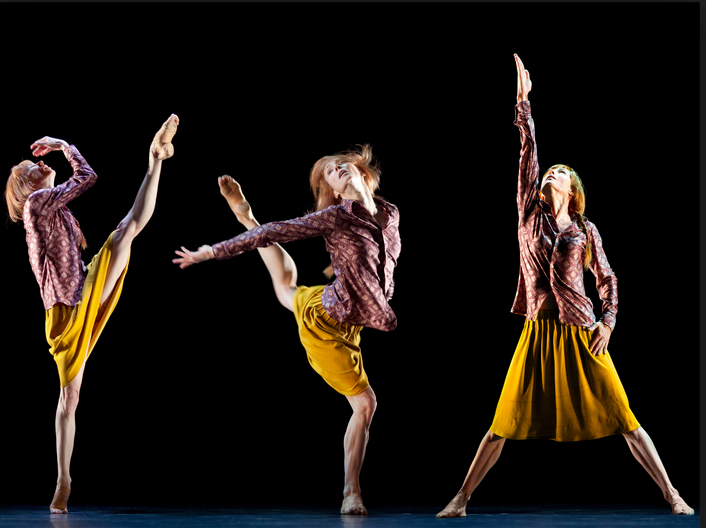
Sylvie Guillem in flight. Amazing. I feel honoured that I got to witness her dancing, live, before she bows out.

Sylvie Guillem in flight. Amazing. I feel honoured that I got to witness her dancing, live, before she bows out.

Guillem is about six weeks older than me and has decided to call her career while she’s still on top of her game and, oh man, she is. Her dancing was unbelievable, especially her final solo piece, ‘Bye’. Astonishing.

Even better, her goodbye tour is titled: ‘A life in progress’. No ‘best of’ dancing for her; instead she’s still pushing herself, exploring, until the moment she steps off the stage. Even then, Guillem’s mantra is that she will no longer be starring in international productions, as she has been since Rudolf Nureyev strode onto the stage after her debut in Swan Lake, and announced she was now the French company’s étiole (top dancer) when she was at the absurdly young age of 19. But she’s not disappearing either. Her take is that it’s time for the next thing, whatever that is, and her life in arts will continue somehow.

Plus she’s a massive supporter of the Sea Shepherd and had Shepherd supporters selling merchandise at the Opera House, which was an unlikely scene. I bought a beanie I didn’t need, just because. She rocks.

Sylvie Guillem. This, peoples, is elite fitness. Pic: Balletoman.

Sylvie Guillem. This, peoples, is elite fitness. Pic: Balletoman.

Over cocktails at Palmer & Co, post-performance, Chloé and I chatted about Life After. I wondered how Guillem will eventually cope with not being so outrageously fit, flexible and just physically incredible, once she retires and drops at least a level or two in training and physical commitment. I think anybody who has worked hard enough to be elite fit, as in really fit, understands what it’s like to drop back to ‘pretty fit’ or even ‘very fit’. Let alone, ‘yeah, kind of fit’.

Guillem has been training remorselessly since she was 11. Thirty-nine years of being at the top of her game. It will take an adjustment, when she realises she can’t just do a vertical split without thinking about it.

The Large No. 12s, at the Labour In Vain, with Tiger Mick on guitar (in the back, far right) and a lead singer with a working back.

The Large No. 12s, at the Labour In Vain, with Tiger Mick on guitar (in the back, far right) and a lead singer with a working back.

But all manner of levels of fitness after 50 can be done and there are many inspirations around me. Tiger Mick is one of my Bang footy brothers. He’s well over 60 (I’m too polite to ask exactly how far) and recently lost a year of Bang action to an infected toe. There are infected toes and infected toes and my understanding is Mick almost lost his, the big toe on his right foot (kicking foot). He’s finally back, running and racing around like a maniac, as always, even tackling much bigger guys, against the Bang rules, and mostly kicking left foot. I watch him and think: if I was 60+ and lost a year of muscle in my legs (i.e. most of the muscle mass) I can’t see myself just jumping straight back in and running running running once given a half-all clear by a doctor. On weekends, Tiger Mick and a bunch of his mates play music in pubs across the town. We went and saw them recently at the Standard in Fitzroy and the lead singer was playing guitar and singing, while sitting down, with his back against the back-wall of the stage. ‘Is that some kind of rockstar affectation?’ I asked Tiger Mick. “Nah, he’s done his back but if he didn’t turn up, we don’t get paid,’ Mick shrugged. These guys are unstoppable.

Magnificently vintage Shonko battles the red dust of central Australia last week.

Magnificently vintage Shonko battles the red dust of central Australia last week.

Likewise, my friend Shonko has just got back from racing mountain bikes at Alice Springs. He finished about 30th overall and second in his division, which was, hilariously, titled: ‘Vintage’. Shonko a few years ago was riding in the age group 24-hour off-road mountain bike titles in Banff, Canada, where you ride and ride and ride for 24-hours around a 13 kilometre course, and he was so fit it was just ridiculous. We actually stopped going bush together because I felt bad that all super-rider Shonko did was wait for huffing puffing me to catch up. He always said that didn’t bother him. These days, he’s stepped it back to shorter races and to more fun challenges and doesn’t seem the worse for it. In fact, he has a better life balance while still being fitter than most 50-year-olds could dream of.
Giddyup. Pic: Luke Milkovic

Giddyup. Pic: Luke Milkovic

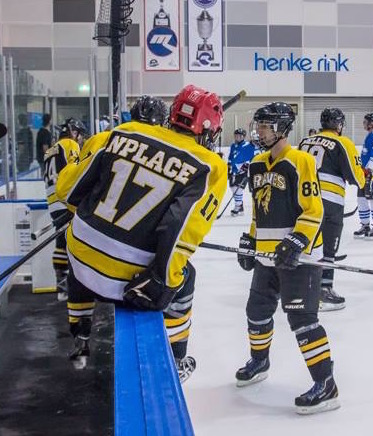
Me? I’m a few steps behind him, feeling my way back towards the level of fitness I want, which enables me to compete at hockey and to live my life. My problem/joy has always been that I have too many irons in my far too many fires. It’s impossible to be super-crazy-fit while also running a company, raising kids, writing novels, being social, embracing art and culture, writing for TV, and all the other stuff I do. But after a much-needed break after last summer’s season, I’m starting to build my lungs, legs and momentum towards this season, and it feels good. I’m nowhere near my version of peak fitness yet but I can feel it getting closer. Footy on Sundays, Inter and maybe Dev League on a Wednesday night (even though I was straight-out appalling last Wednesday: one of those nights. Yeesh) as well as occasional gym, running sessions, 50 push-ups and 100 sit-ups (minimum) per day, and riding my new mountain bike. This morning, spring in the air, I rode this incredible machine through the streets of inner Melbourne, past the MCG and Punt Road Oval (Go Tigers!) and then wound through the back streets of Cremorne to the Giants HQ. My hands were freezing in the morning wind but my legs felt good, pumping the pedals towards another summer and another Cherokee adventure. It’s going to be a different season: several of the old Cherokees have moved up to Division 2, pushing onward, higher, but enough of the old ‘Kees still around to make our changeroom the fun, slander-filled space that I love. Can’t wait to pull No. 17 over my head, clip my battered red helmet to my head and go chase the puck.

Sylvie Guillem might feel it’s the right time to go, but I sure don’t. I’m sticking with Tiger Mick and Shonko, in the Old Enough To Know Better division, also known as Vintage.

Bring it.


A Reality Check, in more ways than one.

This has been a little slow coming because I got distracted by manta rays and sharks, and then by coughing my lungs up for a few weeks. But in the middle of all that, on a remote island way off the coast of Queensland with no WIFI, I had the time and space to finally finish reading Will Brodie’s excellent book, Reality Check.

Will recently wrote for this blog about his two-phase hockey life, and, as you’d probably expect from a long-time mainstream newspaper and online journalist, the guy can really write. His regular AIHL reporting over the past few years was a huge, possibly under-recognised boon for the sport and is sadly missed since he quit Fairfax.

Reality Check, by Will Brodie

Reality Check, by Will Brodie

But his best work was yet to come. Last season, he followed the two Melbourne teams as they navigated their way through the trials, highs and lows of an AIHL season. He lucked out in the sense that the Mustangs came of age, eventually winning the Goodall Cup  over, guess who, the Melbourne Ice (and yes, I realise that is potentially a massive spoiler but then again, if you’re an Australian hockey fan and didn’t know that, then you’ve been off the map in ways I can’t help you with).

So Will got a good yarn, as Melbourne’s fierce-but-sort-of friendly rival teams duked it out all the way to the grand final at the Icehouse, but it’s the wider story and the wider characters of Reality Check that stayed with me. Will’s long history in the sport means he was able to really tap into the people who have kept hockey going in this country for years. Yet he also brought fresh eyes, making him an unlikely and invaluable chronicler. He was able to have detailed, knowledgeable conversations with everybody from new fans to the game, happily getting pissed pre or post-game, through to club presidents and imports, in every hockey-playing city and town in the country. Will sat in team mini-vans, sat up late with coaches and traveled to every AIHL rink and explored the nooks, crannies and idiosyncrasies of those diverse locations. All while throwing in lines like the one about a venue being so cold it offered warnings of future arthritis in his bones.

It all made for a cracking read, and I found myself emerging with three major takeouts:

  1. We need more rinks. A lot of people have been saying this for a long time but Reality Check emphasises the point over and over again. Hockey has enjoyed a huge surge in popularity over the past five years or so, in terms of AIHL fan numbers but maybe even more so in terms of newbies taking up the sport (like the guy typing these words, for example). Already, there is a crush of new players on waiting lists to play the looming IHV summer season that starts in September or so. Winter lists in Melbourne are pretty much full. Throw in training times, for clubs from the lowest social hockey levels to AIHL sessions, Next Level classes at Oakleigh, and Hockey Academy classes at the Icehouse (both at or near capacity), drop-in, and stick-n-pucks or skating sessions, and Melbourne’s two hockey rinks are loaded beyond capacity. I haven’t even mentioned speed skaters, figure skaters or other groups who also want the ice.
    Everybody knows the lack of rinks is an issue – and across Australia, not just Melbourne. There are endless plans, endless rumours of new rinks being developed, waiting for council approval, waiting for finance … but I remain worried that by the time new ice actually happens, if it does, all those wildly enthusiastic new players currently flooding the sport will have drifted away, frustrated by their inability to join a team and play. (Or by the secondary, related problem: that because two rinks can only host so many teams and therefore so many levels of competition, wildly varied levels of skill end up in the same divisions, leading to less-accomplished players feeling overwhelmed by playing hockey against skaters who should really be a division or two higher, if only there was room.)
  2. God, there’s a lot of love behind the momentum of an amateur sport like ice hockey. Time and again, through Will’s book, I was struck by the sheer commitment and dedication and hours of work being poured into the sport by people who have kids, real jobs, need sleep, have other things they could be doing. Again, just by kicking around Victorian hockey at the low level I do, I’m aware of how much work is required and is done by friends who are on committees, or within club management teams, or chasing sponsors, or scoring games, or doing the million other jobs. It’s really humbling and those of us who are not devoting themselves to helping hockey grow in such a grassroots, practical, time-consuming way, should at the very least take a moment to respect those who are. I know I do, and even more so after reading Will’s book, with his eye for those toiling glory-free behind the scenes. In fact, next time there’s a petty squabble about whatever the tempest of the moment is, wouldn’t it be cool if everybody could step back and consider how many unpaid hours the person they’re attacking, or who is attacking them, has put in? Breathe, respect one another, sort out whatever the issue of the moment is. And move on, brothers and sisters in hockey
    … (I know, I know: us idealists have no clue.)
  3. Us Newbies should remember we are Newbies. I’ve been around local hockey since 2010, having ‘discovered’ hockey, through somehow tuning into the Detroit Red Wings, in 2008. It feels like a long time, but it really isn’t. I feel like I know a lot of people in the community now and feel blessed that I happened to start this blog, on January 19, 2011, by chance at the exact moment a whole bunch of others were also discovering AIHL competition and the then fairly new Icehouse facility. Just as the early classes run by Army, Lliam, Tommy and co were taking off. And just as the Ice went on its three-peat run, the grandstands swelling, and the Mustangs arrived. And just as Next Level Hockey was gaining momentum at about the same time. Watching some of the rookies I started with kick on, even now making it to the AIHL rosters.

    The Melbourne Ice players salute the fans after a recent win at the Icehouse. Pic: Nicko

    The Melbourne Ice players salute the fans after a recent win at the Icehouse. Pic: Nicko

I feel like I’ve seen it all but reading Reality Check, I was struck by how people like me are still newcomers to the ranks. There are many people in Australian hockey who have invested decades into the sport they love. In Nite Owls competition, I once had the joy of skating with a bloke who captained Australia’s hockey team 50 years ago, and is still out there, on a Sunday night, effortlessly gliding past a flailing hack like me. But there are also so many others, such as, in my immediate orbit, the Webster family, driving the Ice team and club, on the ice and off, and the Hughes brothers, with their Oakleigh dream and Joey’s intensity and passion that inspires so many rising players, from L-platers to accomplished skaters. Next Level has evolved to the point of having its ‘Next Generation’ program, with a lot of thought and structure behind it. Meanwhile, at the Icehouse, the classes have become more and more sophisticated so that academy students can work specifically on high level skating skills or puck-handling, or game play, or pure shooting. It’s really exciting and it’s impressive, and it all happens because of the long-term and tireless commitment of actually only a few people. Will’s book did a brilliant job of shaking so many of these decades-of-service servants of the game into the spotlight for a brief moment, while never also losing sight of the fact that the sport needs to embrace the new arrivals, the fresh-thinkers, the left-field recent converts who might just take the sport to places it hasn’t been.
This has been a rambling piece. The only point of this particular blog is to add my voice to Will Brodie’s and salute the people who have made our sport rise in Australia and are now working equally hard to accommodate the growing numbers and logistical nightmares of its popularity.
And to say to Will, congrats: he has written one of the best hockey books you or I will ever read, and tied up in a bow everything that is great and worrying and awesome and frustrating about chasing a puck across a block of ice half a world away from the hockey heartlands.
If you haven’t bought Reality Check and read it, I really recommend that you do.


Splattered

Driving to hockey training on Wednesday, it crossed my mind: is this a good idea?

On Tuesday, I head to one of my favourite places in the world, Lady Elliot Island, a tiny speck off the coast of Queensland at the southern base of the Barrier Reef. Mackquist and I are going to dive for a week with the manta rays, and hopefully a whale or two if one passes while we’re underwater (which can happen at this time of year).

Lady Elliot Island - so small that the strip across the middle is the runway.

Lady Elliot Island – so small that the strip across the middle is the runway.

It’s peak manta season and I can’t wait to get on the plane, to see if you can really leave Victorian winter and be in the warm Queensland waters with up to 30 or more mantas at a time.

So, driving to training, the thought strayed into my brain that this would not be a good night to hurt myself. But just as quickly, I dismissed it, thinking: you can’t live like that. I’ve skated constantly now for more than four years and have mostly been okay. Why should a standard Wednesday Intermediate class be any different?

And so yes, you know what happened. About ten minutes in, Tommy Powell calls for two quick laps and off I go, skating as fast as I can. I actually love those fast laps: they kill your legs and lungs, but in a good way. It’s the best cardio workout I get all week. And so I throw myself at them. If I’m not the fastest skater out there, and invariably I’m not, at least I’m working hard.

Right up until a goalie was stretching near where I had to turn left, to pass behind the goals, and that made my turn a little sharper than I had planned, especially at speed, and before I could process it, I’d lost an edge on my skate and I was down, bouncing off the ice and careering, completely out of control towards the boards, less than two metres away and closing fast.

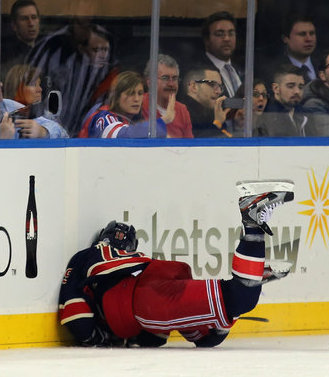
This is NOT how you want to hit the boards. Somehow, Ranger Brad Richards came out of this okay.  Pic: Getty.

This is NOT how you want to hit the boards. Somehow, New York Ranger Brad Richards came out of this okay. Pic: Getty.

Without trying I can think of five cases where I’ve witnessed a hockey player in this situation end up with a broken leg or collar bone. I can think of other lesser injuries, but still significant ones from uncontrolled slides into the wall.

I’ve had it happen a couple of times and had a badly hurt shoulder/upper neck from one of them.

All of this somehow had time to pass through my mind in the micro-seconds before I hit the boards.

I’m sure I’ve written in this blog before about once doing laps with Bathurst-winning racing car driver Jim Richards. I asked him: what’s it like when you go sideways and you know you’re going to hit the wall? What passes through your mind?

He stopped, squinted, thought about it and said, surprisingly, that he’d never been in that situation.

I said: you’ve never hit a wall?

And, to paraphrase, he said: no, I’ve hit plenty of walls, but here’s the thing … a racing car is an incredible piece of machinery. It can do things that a normal car simply can’t do. And I am a highly trained, expert driver, so I can drive that car in a way people normally can’t. So, if things have gone pear-shaped, I am doing everything I possibly can not to hit the wall … right up until the actual moment that I hit the wall. If I think about it, it’s always a bit of a surprise to hit the wall, because I was concentrating, working so hard not to, and then oh wow, I hit the wall.

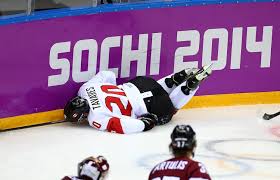
Another nasty board collision. You do not want to lose an edge while heading towards the wall.

Another nasty board collision. You do not want to lose an edge while heading towards the wall.

Richards’ answer has become one of my central pieces of life philosophy: until you hit a wall, do everything you possibly can not to hit that wall. (Even if you end up crashing into whatever the wall is – and believe me, in life, I have hit my share of walls – you can comfort yourself with the knowledge that you did everything humanely possible not to, despite the fact you failed.)

But on Wednesday night, this all went out the window. Skates off the ice, 85 kilos of full body momentum sliding across the surface, at velocity, with two metres or less to stop, and no way to brake, I had no hope.

Time did helpfully slow down enough for me to think: Oh shit, Lady Elliot! Oh crap, mantas! Oh fuck, Macklin will kill me …

And I also somehow had time to think: do NOT stick out an arm or a leg to take the hit. I was a relaxed ironing board in armour when I collided – and it was a beauty. I hit the boards hard. Helmet took it. Right shoulder took it. Knee took it.

But a miracle. No joint got bent the wrong way; my helmet did its job. Two days later, I’m completely fine; a vague dull ache in my shoulder but nothing to stop me boarding a plane and diving.

Such a relief.

Later in the session, I went for a puck from one direction as a classmate came fast the other way. Again, the collision was a big one. Again, I skated away, intact.

Double sigh of relief.

Today I got an email from one of my brothers at the Bang, our social footy group. He wanted to know if anybody wanted to play in a real game of Aussie Rules, to help a team he knows make up numbers, this Saturday only.

No, I wrote back, as quickly as I could type. No, I will not be putting my body in line to twang a hammie or do a big knee. Not with Tuesday’s flight looming.

For once, just this once, I am letting myself be grateful I survived Wednesday’s big hits and I’m voluntarily putting myself in cotton wool between now and Tuesday. It’s all about Mackquist, the mantas and me.

My final dive, with a manta on the surface, at Lady Elliot, a few years ago:


Each to their own

I went to the soccer last Friday. A much-hyped A-League semi-final and a Melbourne derby for flourish, between the Victory and City.

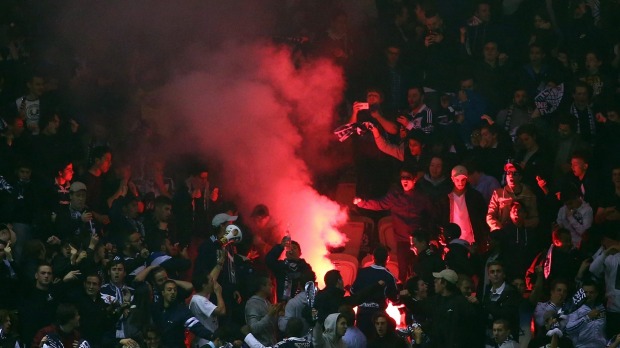
Soccer fans getting passionate.

Soccer fans getting passionate.

Soccer makes such a minimal impact on me as a sport that I literally can’t remember if it was my first A-League game or not. I have a dull feeling that I might have gone to one once before, but if I did, I couldn’t tell you who played, let alone who won.

Yep, it may be The World Game but not in my world.

But that’s okay, because it was a fun event. On a classic Melbourne night, the sort of night where there were 50,000 at the MCG to watch Collingwood-Geelong and who knows how many thousands watching a rugby union game at AAMI Park, and who knows how many more thousands watching the Backstreet Boys at the tennis centre, I was among the 50,000 people gathered at Etihad Stadium on a freezing but clear night. Victory started favourite, got a goal after 18 minutes (I know this because by some random chance I had selected the correct player as opening goal scorer in the sweep, but got the scoring minute wrong by 6; thereby totally bluffing the people around me that I had some kind of clue about the game, and almost winning a decent cash prize) and Victory controlled things from there.

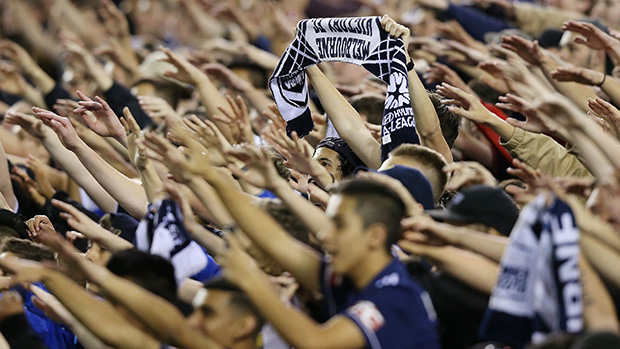
Victory fans having fun. Pic: Getty.

Victory fans having fun. Pic: Getty.

I sat, not really caring, but happy to let the occasion flow over me; even chatting to an ex-Socceroo who happened to sit next to me. (My bluff of knowledge came to a crashing end when I had to confess I had no idea his son currently played in the EPL or for the Socceroos.)

Mostly, I watched the fans. Because they were seriously into it. My biggest immediate take-out was that it was a larger male crowd. I’m used to AFL crowds and AIHL crowds, and they are both heavily mixed gender. I feel like I can’t confidently say whether a Melbourne Ice or Mustangs crowd would be skewed more male than female. Likewise, AFL is probably not 50-50 but there are many women there, and passionate about the game.

On a casual observation, the soccer crowd felt male – between 20 and 50 years old. And it was an occasion for these men to go nuts. There were the usual flares and horns and chants. As Victory took the ascendancy, an entire stand to my left was heaving with people dancing and chanting and waving. The atmosphere was fantastic, yet I felt totally removed, like I was at the zoo, watching from behind glass.

Soccer fans having fun.

Soccer fans doing their thing. I’m not judgmental: Red Wings fans like to throw octopi on the ice.

It got me thinking it’s so strange how some sports can grab your soul and others leave you totally cold. Like, cricket is polarizing in a love it or hate it manner, and so is American football.

I have watched and reported on and experienced and studied many sports over my 30 year journalistic career, aside from being an enthusiast, and I can say with certainty that I am resolutely unmoved by basketball, soccer and baseball. I never had much time for NRL and still don’t really, except that a couple of people who understand the game have explained subtleties to me that made it more interesting as I watched. I can stomach it now but I still wouldn’t pay for a ticket.

Rugby union, when it’s flowing and it’s an important game, like Australia in a World Cup, can be exciting. The characters and sheer danger of boxing, as well as the strategy and fitness, has always gripped me. Tennis lost me, largely, after I had to spend too much time around certain Australian prima donna tennis players, and after I had to watch too much of it as a reporter, and in places where the matches simply didn’t matter: a second round loss for a player just meant an earlier plane to the next city. When the stakes were Grand Slam high and somebody as good as Sampras, Graf or Federer was at their peak: then it got good.

But that’s just me. Whatever you’re into is fine. In fact, English Premier League soccer (and yes, I use the word soccer as an abbreviation of ‘Association Football’, especially because the Melbourne Football Club was formed before any of the English clubs, so screw you ‘world football’; okay, that’s another story) but EPL soccer is kind of like seafood for me. I don’t enjoy eating fish. Some of it I really dislike, while certain flavours of seafood I can tolerate. But when everybody around you is having a mouth orgasm because the food is so amazing, and you’re just ‘tolerating’ it, you feel guilty and wonder what is wrong with you? What are you missing, and why? I’m like that with the EPL competition. So many of my friends have EPL teams, follow it in the middle of the night, start work conversations with a quick discussion of last night’s results or pending big money transfers … and I have nothing to add.

It doesn’t mean I’m against it; not at all. A really great game of soccer can be fun to watch, especially if it’s attacking and end-to-end and the crowd is at fever pitch, but you know, shrug. The World Cup can be fun.

One of my mobs. Go Tigers!!! (you hopeless, underachieving bastards)

One of my mobs. Go Tigers!!! (you hopeless, underachieving bastards)

By contrast, Australian Rules has held me from before I can remember to now, when Richmond continues to be remorselessly shit, no matter what, and when I still run around, feeling the leather with a bunch of men old enough to know better who gather once or twice a week for the pure joy of landing a pass in the outstretched hands of a fellow player on the lead.

Hockey? Well, hockey grabbed me from the moment I turned on my television years ago now and saw my first Stanley Cup final game between Detroit and Pittsburgh and something in me stirred. Immediately. Grabbed me! Made my heart beat. Has seen me holding my head in my hands, screaming at Gamecenter as the Wings performed miracles or screwed up, soaring as the Ice achieved the three-peat of cups, slumping as the Ice lost last year’s grand final; even physically taking on such a crazy sport as an activity, having never skated.

All of that. All. Of. That.

Blood pumping. Passion burning. Feeling alive.

One of my other mobs: The Cup-winning Red Wings that captured my heart.

One of my other mobs: The Cup-winning Red Wings that captured my heart.

Which is why I found it so strange, so abstract, that I could watch those Victory fans last Friday night, screaming and yelling and jumping up and down and foaming at the mouth, and realised that I was just staring at them, completely unable to bridge the gap between us. The bridge of caring.

And I found myself wondering how many pieces of silverware are fought for across the globe, in how many individual sports and individual competitions within those sports, and by how many teams and cheered for by how many millions, whether from NFL to Brunswick trugo? Somebody everywhere willing to bulge at the jugular, to ride that scoreboard or that goal or that umpire’s decision; that bounce of a ball or a puck or a footy or a punch or a shot; the fans’ sporting existence living or dying on the fortunes of that moment in their chosen passion.

Ice v Mustangs at the Icehouse. Now we're talking ...

Ice v Mustangs at the Icehouse. Now we’re talking …

There’s no deep meaning to any of these observations. It’s totally okay. Those Melbourne Victory and City fans would probably stand on the glass, politely observing, when the Ice and Mustangs were going at one another’s throats, and be wistful that nobody is throwing flares.

Each to their own, I say, and go the winner in this weekend’s A-League grand final.

I wish those chanting, excitable hordes well.

I’ll just be watching the hockey and the Tigers. It’s what I do.


The end of another summer?

Tonight, I potentially play my last game of the IHV Div 3 2014/15 summer season. My team, the Cherokees, has a game next weekend to finish the regular season but I have a wedding I can’t miss and so tonight, at 10.30 pm at the Icehouse against the Champs, is it for me. Except that we’re going to win tonight and therefore play finals in a couple of weeks, but that’s for another blog.

As always, as the end of the official season approaches, I feel melancholy. There are aspects of being in a team, of sharing adventures with the same group of people, that are impossible to capture elsewhere. It’s something I cherish because I only watched it from the outside for so many years as a sports journalist while, as a kid, I was more of a surfer than a footy player and only played indoor cricket with some mates for fun. The Bang, my winter footy world with a bunch of similarly creaky Sherrin-chasers, goes close but we don’t have actual matches, we don’t skate onto the Henke Rink needing to win to make the finals. That sort of adrenalin is hard to bottle.

I haven’t written the blog since returning from Christmas because there hasn’t been much to write about, in a hockey sense. I’ve been training on Wednesdays, very much as per the final blog of last year, where Tommy, Lliam, Army and Shona own our arses in dev league after we complete drills in Inter class. We’ve played some Cherokee games and continue to get more cohesive and dangerous as a team, just as we’re going to have to stop.

In my happy place (pun intended): playing the goon for the Cherokees.

In my happy place (pun intended): playing the goon for the Cherokees.

Away from the rink, I’ve been on an intense fitness campaign – including a non-negotiable minimum of 50 push-ups and 100 sit-ups per day, over and above hockey training, gym workouts and other fitness – and feel great for it. It’s kind of annoying that I feel like I’m hitting peak fitness at the exact moment I’m about to stop playing competitive hockey.

On Monday, I even walked to work, and therefore found myself wandering past the Punt Road Oval just as my beloved Richmond footy team was warming up for training. Somebody had left a gate open and that’s all a former journo needs to sneak in and take a seat … I eventually made myself useful by collecting the balls that were kicked too high for the epic netting behind the goals (about one in five shots), so that I felt like a little kid again, scurrying around behind the goals at the school end of Lorne’s Stribling Reserve to get the footy as the Lorne Dolphins took on their Otway opponents, surf booming from down the hill.

But I digress. It was fascinating watching the Tigers go through their routines. It’s a long time since I’ve been to an AFL training session. As a journo, I hung out at training all the time and mostly took it for granted but now I saw it all through fresh eyes. The Tigers warm up using many of the time-honoured techniques all footy teams do, such as two players sharing one ball, playing kick-to-kick from 20 metres apart. Even us Bangers do that before starting to run around, but Richmond puts a little spin on it: instead of standing, flat footed, to mark the ball, then kick it back, the Tigers mark it, turn, take four or five steps backwards, then pivot and deliver the pass back to their mate. It’s recreating the movement of taking a grab, and then retreating from somebody standing on the mark, to turn and bullet a pass to a teammate. Kicking with one foot and then the other. Even before their hammies are vaguely warmed up, they’re recreating match conditions.

They weren’t finished. After a while, the players took to marking the ball, then dropping it and letting it bounce on the ground a couple of times before they bent, picked it up and kicked before straightening. Again, in a match, you don’t have time to scoop up the ball, stand straight, balance, look around and then kick. So at training, they’re kicking from a half-crouch, having snared the ball on a half volley.

Jack Riewoldt shows his style at training.

Jack Riewoldt shows his style at training.

Everything had a meaning; everything had purpose. When a coach called ‘drink break’, the Tigers ran back to their drink bottles as fast as they possibly could. I mean: sprinted! It was like there was a thousand bucks cash on the boundary near their bottles. In a game, you don’t jog back to the bench, you get the fuck off the playing surface so your replacement can get on. One player yelled: ‘This is not a drill, peoples. This is not a footy drill!’ just to be a goose, but that’s where I started to see the correlations between what they were doing and hockey training. Sprinting to the boundary, for example, has direct application for hockey. If you’ve ever played in a team with somebody who dawdles back to the bench, stick in the air, because that’s how they’ve seen the NHL players do it … while you’re watching your team now a man down on an opposition breakaway, you’ll know what I mean. If you’re going to end your shift, skate hard to the boards, peoples.

At our training, the coaches endless ask us to skate fast over to the whiteboard so they can explain the next drill, but people saunter back, grab a drink, gradually tune in. The Tigers, professional athletes, are there, drinking, in a flash, and then on their way to the next activity with intent. Impressive intent.

The other drill that caught my eye was when they started doing run-throughs. Six or seven Tigers would leave one end of the ground at a time, running at maybe 60-70 per cent. As they approached the cones 150 metres away, a coach would be standing with a Sherrin in his hands. He would fire a handball to one of the running players, but they didn’t know which until he suddenly rocketed the ball to them. Lightning fast hands snared the ball in one grab every time. In hockey, a lot of our drills are choreographed, as in ‘Man A leaves this corner, skates around this cone, looks for a pass from Man B who then skates to here to receive the pass back before the blue line’. The Tigers add a little matchday randomness to everything, because in a game, you don’t have the choreographed puck arrive just as you’re ready for it after rounding a cone. In fact, hockey games and AFL games are very much about making snap decisions and of having the puck or ball arrive sometimes unexpectedly.

This is not to say footy training is better/smarter than what we do at the Icehouse. I fully get that hockey skill drills are a different beast to the Tigers’ match day recreation stuff and that we hockey rookies need to have drilled into us over and over again how to break-out, how to form a three man rush, how to pass in front of a skater, not to their feet … these are basics that we need to keep working on but the Tigers don’t exactly have to worry about. And anyway, at the Bang, one of our elders, a well-known singer songwriter, is forever trying to get us to do a three-man handball weave as we run warm-up laps, but it’s laughable how incompetent we all are at such a basic move. It drives him insane. Sometimes, hockey players and footy players are better when acting by instinct, instead of trying to handball to here, move from point A to point B, receive the ball there, move from Point B to Point C.

And then, anyway, the Tigers surprised me and made me laugh, by doing a drill that was so robotic and synchronized that it looked like a line-dance.

The whole thing was fun to watch, and scamper around, collecting footys. I walked the rest of the way to work and back to my real life, looking forward to the AFL season starting, so that the Tigers can prove they’re finally the real thing. The calendar clicking ever closer to footy mode also means the Melbourne Ice women will have secured the title by then, which means the Melbourne Ice men will be ready to show the Giddyup Clippy Clop Orange crowd that last year’s final was just a bad day on the wrong day.

Me? I’ll be spending Wednesday nights on the ice with Big Cat, and Sundays at the Bang with my footy brothers, occasionally, hopefully, scuba diving with Mackquist, and all the time wondering if my creaky old body has another summer of competitive hockey left in it? As I do every year. Before I inevitably sign up and pull the Cherokees No. 17 jersey over my shoulder pads, chasing that locker-room brother-and-sisterhood that I adore and the sheer thrill of the battle. I love it all. There’s life in the old dog yet.

Ho Ho Ho Homiliation!

The player skates fast, flying on edges, behind my net and I move to block the space where he has to come out. He flicks the puck straight over my stick, catches it and then taps it between my legs. As I try to process this, which has happened inside less than a second, he’s gone, like smoke into a flame, and by the time I turn around he’s skating through the blue line.

‘Goddamn it, Army,’ I call when I’ve skated to a point where I can yell at him. ‘You could at least try to pretend like that was difficult.’

Lliam Webster moving at maybe 50 per cent capacity during the coach scrimmage. Pic: Nicko

Lliam Webster moving at maybe 50 per cent capacity during the coach scrimmage. Pic: Nicko

Matt Armstrong, Melbourne Ice star, Canadian and former European pro, just laughs and apes my habitual legs-too-far-apart stance and cruises effortlessly away, faster than my fastest skating. I cuss quietly to myself and go chase the puck, because now Shona, captain of Melbourne Ice and Australia, is streaming through the middle and I know a pass will be coming if I can get to the right spot.

The final night of Hockey Academy at the Icehouse is always a lot of fun. Our coaches throw away any pretense of teaching – apart from schooling us in real time on the ice – and jump onto the ice for a scrimmage.

It’s actually not humiliating at all – I just really wanted to use that headline. It’s a night of miracles and wonder, although not in the Paul Simon kind of way. It’s a night where you can battle your way to the far goalpost and pretty much know that Tommy Powell (Australia and Melbourne Ice) will somehow weave the puck through eight legs and four sticks and a goalie, to land it right on your tape for the tap-in goal. It’s a night where Lliam Webster (captain, Melbourne Ice and Australia) will calmly stick-handle for what seems like an eternity, all within half a metre of his body, as hockey students flail and fail to steal the puck. It’s a night where goalies have nightmares, watching giant Melbourne Ice defender Todd Graham wind up from the blue line or watching Matt Armstrong come swinging in, deeking and curving, all angles and power, winding up and then last-second passing off to a player they hadn’t noticed to their left who has an open net. Or where Shona will just skate alongside a player, gently separating him or her from the puck without them quite realising until it’s too late.

It’s so much fun. And it reminds you how good the best actually are.

I’ve been really lucky to experience this moment across several sports, from my time as a sports writer. I once drove laps of a raceway with Bathurst veteran Jim Richards in his Targa Rally 4WD Porsche. It had rained – real Queensland rain – for an entire day beforehand and the track, on the outskirts of Brisbane, was underwater. Richards drove at roughly 200 kph around wide corners and faster down the straight, hurtling past smaller, hard-revving cars before jamming the brakes, screw the weather, to take a sharp right hander. Then flooring it, going through gears back to 200 or so. While doing this, casually chatting with me – I was surprised how easily we could hold a conversation given the screaming engine and the fact we were both wearing race helmets.

shona coach scrimmage‘So, what do you think?’ he asked me, looking across to the passenger seat and grinning as the car sliced impossibly fast through water and revs and blurred landscape.

‘You’ve got the best fucking job in the world,’ I said, meaning it, and he laughed, shoulders shaking, even as his hands and legs worked the car down through gears and brakes for a corner coming up, like, NOW.

People asked me later if I was scared but I wasn’t at all. In fact, what struck me more than anything was that this was Richards driving at a sponsor open day, giving supporters (and one feature writer) laps in the car. He was probably driving at 70 per cent of capacity, not about to push the car anywhere near its limits with passengers alongside. The speed and torque and thrill weren’t even at maximum revs, which had me wondering what it must be like when he really turns it on.

I had the same thought once in my tennis writing days. I can’t remember if I’ve written about this before but I used to play a lot of tennis and I hit possibly the best serve I can ever remember hitting in my life to Jason Stoltenberg, then a top player, at a Tennis Australia media open day. I decided, on a big point in a friendly doubles match, that there was no point playing for percentages. Stolts had been chirping me mercilessly as I bounced the balls at the baseline, preparing to serve, and so I wound up, swung from the ankles and somehow, against all the odds, absolutely creamed it. I swear I could not hit a tennis ball any better than that and my serve was the best part of my game. This one was aimed at the sideline of the backhand court and it hit the outside edge of that tramline, skidded off the paint and was gone, man, gone.

I barely had time to register the extent of how legendary I was, before a green blur passed my feet as it landed just inside the baseline and disappeared. Stolts had taken maybe half a step to his left and effortlessly backhanded the return past me before I finished my follow-through.

Lliam at full capacity during the coach scrimmage. Pic: Nicko

Lliam at full capacity during the coach scrimmage. Pic: Nicko

I couldn’t disguise how absolutely gutted I was (yes, my partner and I lost the set), and he almost died laughing, but later I told him it was instructive. Hanging out on the tennis tour, and hitting a few balls here and there, reporters would start to think it doesn’t look so hard, maybe with the right practice I could get out there and aim for Wimbledon … some even entered qualifying for the satellite tour, the lowest rung, and got found out quickly.

But Stolts’ almost-yawning return of my absolutely best ‘100 per cent can’t hit it better’ serve ensured I never had those delusions. (My dad was a genuinely competitive Australian tennis player and thought about going on the world tour when it was ‘shamateur’, but then one day he had to return serve to Neale Fraser at training and Fraser broke 13 strings on dad’s racquet. Dad became an engineer.)

It runs through all sports: think how bloody good at football all those kids who don‘t get drafted into the AFL are. Think how impossibly good Test batsmen are, or bowlers.

So last night, I was there again, being reminded of just how impossibly vast the gap is between those at the top and us everyday mortals. And this is with Tommy, Lliam, Army, Todd and Shone operating at maybe 50 per cent capacity if we students were lucky. And without taking anything away from our coaches, it needs to be remembered that there are then clear levels above them before you get to the rarified air of the AHL and elite Canadian or European leagues, not to mention the NHL. Just how fucking good must Pavel Datsyuk be? Or a younger Wings lesser light like, say, Tomas Jurco, for that matter? Not that either of them are scoring any goals just now, but that’s another story.

Dev League has had a very high standard this term. It’s full of winter players keeping sharp and summer Div 2 players, which means they can play. But the coaches last night made everybody look like P-platers without really breaking a sweat. Not bothering with much armour, getting a puck back if they lost it, just having fun as we worked as hard as we could.

At one point in Dev, Tommy drifted past me as we all set up for a face-off in our defensive end. He said: ‘When the puck drops, just go.’

He nodded towards our goal at the other end. ‘Go.’

As left wing, I huddled over my stick as usual and as Lliam, as ref, dropped the puck, I did as instructed and took off. Didn’t even see who won the face-off. Just skated.

Sure enough, out of the sky comes a puck. Tommy had got it, as he knew he would, and lobbed it high into the air from deep in defence to the red line, the puck landing about a metre in front of me and dying as it bounced so that I could scoop it with my stick and charge the goalie. I have no idea how far behind me the White team opponents were but it felt like I had three quarters of the ice to myself. Of course, I overthought it and tried to go high and the goalie got a glove on it to stop the goal. Dammit. But what a move by Tommy.

Imagine being able to do that. Imagine being able to be like Army who tossed the puck from behind the net over the goal frame and into the goalie’s back and then the goal. Imagine being able to be Shona, not bothering with armour, as she sweeps the puck even off the Melbourne Ice men, turns on the burners and then stick-handles for as long as she needs to before one of us eventually arrives for a pass and maybe even a shot.

Or Lliam who seems to love the crazy stick-handling as mentioned and then the blind pass or the skate-kick pass.

We all struggle to keep up, occasionally feel our hearts soar if we actually manage to poke-check a puck away from one of the coaches, and enjoy receiving their silky passes.

It always means it’s the end of term when we have these games. This time, it’s the end of another hockey year. Every year ticking over gets closer to when playing competitive hockey will get beyond me and so I tend to get melancholy as I drive home through the night. Big Cat wasn’t there tonight either, which felt weird, but I love the hockey community so much that there were endless people to chat with and laugh with and commiserate with after another coach had skated around them, barely breaking a sweat.

After such a shitty week for everybody, with the Sydney siege by that mentally ill crackpot, it was beautiful to be out on the ice, eyes and mind for nothing but the puck. I missed a lot of sweet coach-delivered chances, but I also buried a couple, so it was a good night for me.

Now the skates are drying and my gear is hanging for the final time this year, I’d imagine.

Roll on 2015 and whatever the next hockey adventures are going to be. I can’t wait.

Have a great Christmas and see you all in new year. Let’s Go Red Wings.

Alter egos.

I turned up for work today in what Cassius, our six-year-old, calls ‘a handsome dress’, which is Cassius-speak for a suit and tie.

Less than 12 hours ago, I was wearing my hockey armour, flailing around on the Henke Rink as my dev league team got smashed in the second last go-around of the year.

Next Wednesday will be an even more dramatic change-of-gear (literally) as I have to somehow not drink (much) at a State Library Christmas party before heading to the Icehouse rink for the final Intermediate and Dev classes of 2014. Straight from Christmas formal wear to armour and skates. Can’t wait. I might even see if I can leave my smelly giant hockey bag in the foyer to really make people do double-takes.

One way by day ...

One way by day …

Of course, we’re all living this crazy double life. One thing by day, another by night (or wait, was that Princess Fiona in Shrek? Yes, I think it was).

In my time in hockey (coming up on five years), I’ve played on teams with political advisers, rocket scientists, musicians, an air conditioning repairman, cops, surveyers, lawyers, a doctor (well, he actually never turns up for my team, so I’m not sure I should count him), a video game architect, an editor, nurses, teachers, an alcohol salesman (clearly one of my better friends), engineers, a crazy R&D genius, computer programmers, developers, a landscape gardener, a mad chef, a priest and so many more.

In fact, to write this blog, I asked a Facebook hockey group what people did for jobs away from hockey? In no particular order, hockey players replied:
Electrician, surveyer, project manager, warehouse manager (alcohol – another friend!), engineer, IT managing director, events and communications for a not-for-profit, client relations – finance, NHL professional (sure, Will Ong, sure – I actually have that on my LinkedIn profile. Not much sense of humour on LinkedIn, I’ve since discovered), chief executive officer, IT guy, IT architect, IT analyst, techer/musician/retail manager, admin officer, mechanic (in fact, wind tunnel technician) (!!), myotherapist, sales, senior systems admin, teacher, occupational health and safety manager, IT network engineer, arborist, builder, graphic designer, landscape designer, another electrician, financial planner, logistics manager, unemployed, haematology clinical trial corordinator, hospitality, financial planner, AV technical director, media and journalism student/dental nurse, political and economic researcher/analyst for the Japanese Government (I can verify this – legit), cabinet maker, window cleaner, furniture upholsterer/cabinet maker, computer science student (with ambitions to be a pool boy in ‘one of those movies’), builder, documentation control officer working to be a sports therapist, pharmacy assistant, and finance and operations manager.

That was the response within an hour and, as was debated hotly on the thread, didn’t take into account all the ‘tradies’ who probably aren’t on Facebook at 10 am because they’re actually busy working and stuff … so we can safely throw a bunch of tradies onto that list, guaranteed.

FRIDAY UPDATE: Add to that list: IT, developer, sparkie, sparkie, metal tradie, baker, software engineer, arbourist, air traffic control (Pushing Tin – one of my favourite movies) , brain surgeon, student, lollishop worker, home duties (aka looking after kids), logistics, ‘pro gamer and porn star’ (AKA: the goalie is unemployed, mostly), accountant, public servant, clinical researcher making sure drugs are safe for use (assuming legal drugs here but this is Renee, so…), sparkie, teacher, forklift operator/storeman/shitkicker, cabinet making DJ, concreter, draftsman, physiotherapist, retail therapist, environmental engineer, financial controller, illegitimate businessman (by which Ray means: painter – finest ute in hockey by the way), more IT, business banker, more sparkies, nurse, hand model (made me laugh, Matthew – Seinfeld reference, or Zoolander, or both?),  ‘Build live size animatronic creatures like dinosaurs and dragons. For real(Nerissa Box may win the whole enchilada for that job), mental health worker and IT software developer. Phew.

AAAAAAND, BACK TO THE BLOG:
How cool is that list? I’m sure all hockey players know the moment where you tell people about your sport/passion and get the response: ‘Oh, isn’t that a violent sport for meatheads?’

... another by night.

… another by night.

It’s so not the case. Personally, I think nothing looks hotter than a woman dressed in full executive kit and high heels, carrying a giant hockey bag and sticks along Pearl River Road to the Icehouse. And it’s always entertaining when a player shows up in suit and tie, then yanks all that off to drag chest and elbow guards on. The list of occupations is so wildly diverse and interesting. And it explains why a hockey change-room is such a vibrant, fun place to hang out (except for after a 6-1 loss).

It also means that no matter what your need, from better wiring at your house to requiring an international spy to steal secrets from Luxembourg, you can probably tap into that skill set somewhere among the small but tight hockey community. I was talking to Lliam Webster who said he broke his arm badly, during a game at Oakleigh, as a 14-year-old and ended up at a local medical centre where they did a dubious job of fixing it, and so he ended up at the Royal Childrens where, lo and behold, a senior member of the Nite Owls (Sunday night and social comp ‘veterans’ hockey – see previous blogs) happened to be the main bone guy. Problem solved. Once in the hands of a hockey guy, all due care and consideration was taken and the teenager with the crooked mended bone is now captain of Melbourne Ice and Australia.

To me, this is part of the joy of hockey – that we come from all directions for the one love. Whether in the stands, cheering, or on the ice, skating, it’s a very multi-cultural, multi-class, multi-everything group of people.

I have my usual hockey hangover today, despite the unlikely suit and tie, and a big networking lunch this afternoon. But I know that all over town, others wearing whatever their daytime ‘alter ego’ disguise happens to be, are nursing similar hockey bags under their eyes. That rocks.

Let’s keep it as our little secret, here in this hockey outpost. The non-skaters never need to know.

You can’t go back

Police Squad! - In Colour!

Police Squad! – In Colour!

One of the greatest moments of ‘Police Squad!’, one of the greatest (in my humble opinion) American sit-coms – the forerunner to ‘The Naked Gun’* and Leslie Neilsen’s debut as the magnificent Sgt Frank Drebin – is when Drebin and Ed, his offsider, go to Manhattan’s Little Italy district to interview the widow of a recently murdered man. As Ed dutifully interviews her (‘Did your husband have any enemies? ‘Well, the Democrats didn’t like him.’), she wails: ‘Oh, do you know what it’s like to be married to a wonderful man for 14 years?’ and Frank says, no of course not … but I did live with a guy once. He then goes into a long, non-sequitur reminiscence that is just breathtaking scriptwriting, from where I stand. Breaking the fourth wall, he eventually muses that living with the guy’s son just wasn’t the same.

‘You can’t go back,’ he says wistfully, as Ed asks: ‘I know this is a long shot but did he ever eat chop suey? … it was just a hunch’.

Genius. In fact, dammnit, I might have posted this before because I love it so much but what the Hell. Just spend two minutes watching this. Please.

So the hockey relevance of all this? Well, it’s kind of obvious, I would have thought: my stick died recently.

This doesn’t sound like such a big deal. Sticks are plentiful and if you look behind your average NHL bench, there’s a quiver of sticks for each player, to grab if one breaks – which it often does, given how hard those guys are hitting the puck … and each other, and each other’s sticks.

But I loved my stick. I found it in Chicago in 2011, when Big Cat and I travelled to the outer burbs to a huge barn called Total Hockey. (Mackquist being Mackquist, he’d started the day by saying: ‘Oh, I have a friend in Chicago so I’m going to see her today. See ya.’ and caught a train God knows where …) That left Big Cat and I in a dedicated hockey city, and we made it count. For a couple of Australians used to having to choose from a smattering of hockey kit at Bladeworx in Hawthorn, or the tiny shop at Oakleigh’s rink, or the small selection of gear available for purchase at the Icehouse, Total Hockey was basically Gear Porn.

Picture an entire wall of gloves. A. Wall. Picture racks maybe 25 metres long, with sticks, endless sticks, on both sides of the divide. Every curve that had ever been invented, and every flex variation, length, and brand.

The whole store was like that. Basically, if you’re in Australia, imagine a Rebel Sport store, but ALL HOCKEY. Yes, that’s what we were experiencing. Willio and I walked in and just went: ‘ooooooooooooh.’

I was actually pretty happy at the time with the gloves and the stick I was using back home in Australia. It’s funny, now, three years later, to think how unformed I was then as a player. I guess I still am now, but the Nicko Place who used to wobble around the ice in 2011 would (I’m reasonably sure) get mostly smoked by the Nicko Place who wobbles slightly more efficiently around the ice now. Definitely, my passing and shot were nowhere near what they are now, so it didn’t matter as much which stick I was using.

But as Big Cat held and weighed and considered every right hand stick in the barn, I wandered the leftie sticks and poked around. And then happened to pick up a Reebok, 85 flex, Crosby curve.

My beloved 2011 Reebok stick.

My beloved 2011 Reebok stick.

There’s a scene in the first Harry Potter book/film where Harry goes to the wand shop and is told that the wand chooses the wizard, not the other way around. This felt like the hockey equivalent. For some reason, the moment I held this stick, it felt ‘right’. I just knew this was my stick. It had chosen me.

(I then wandered over to the glove wall and tried on a pair of gloves that sucked onto my hand and form-fitted to the degree that I had the same feeling, that I simply couldn’t not buy them. They died recently as well, so I bought some really decent Easton gloves, had hands of stone for a few weeks, then sucked it up and went and bought the new version of those Chicago gloves. (Vapor A2’s, if you’re wondering.) Now my hands are happy once more.)

But back to the stick. I – or it – was totally right. As my hockey improved and I began actually playing competition, my trusty Reebok stick was a constant companion on the journey. We scored goals together. We learned to saucer pass and cross-ice pass to a moving target. We even flirted with lifting shots to the top corner of a goal. It was with this stick that I scored my first-ever official IHV goal, basically golf-shotting a face-off drop straight between the goalie and the left post at Oakleigh. And where I managed to not score a goal through the most unlikely manner of striking a shot too high at the same end of Oakleigh, so that the shot pinged off the top bar and stayed out. That would have been my first goal for the Cherokees, so it still hurts that I somehow overcooked it.

But time and use caught up with my old Reebok. The toe of the stick started to crumble and became jagged. I began taping the end but finally Army, at the Icehouse, ruled that it was pretty dangerous; that you wouldn’t want to catch somebody with this now ragged fiberglass. I knew he was right.

So Big Cat and I headed to Oakleigh and I tried a dozen or more sticks and none of them had that Chicago moment, of the hockey angels singing as I hoisted My Stick. I bought a Nexus which is a perfectly fine stick, and have spent a couple of months getting the hang of it, to the point that I can now trap pucks, shoot, do all my usual things with it, but it’s never felt the same.

And then last week, I was early for a meeting in Glenferrie Road, Hawthorn, and wandering the strip, happened to cruise into Bladeworx.

Everything old is new again ... the 2014 Reebok.

Everything old is new again … the 2014 Reebok.

There, sandwiched between a bunch of sticks, was a left-handed Reebok, 85 flex, Crosby curve.

Ermergerd!

It’s not exactly my old stick: I think it’s actually a level or two below the technology in the original, but I bought it – $79 off the listed price: thank you, Bladeworx – and used it last night in dev league and it felt great.

I still like the Nexus and it’s cool that I have a couple of sticks to use now, if one breaks. But I suspect I’m going to find myself more and more using the Reebok.

There’s just something about that stick. Sorry Frank Drebin, but you were wrong: when the stars align, you actually can go back.

* NOTE: Police Squad’ is available on DVD and, I think, on AppleTV. It only ran for six episodes in 1982 (two years after ‘Airplane / Flying High’ had hit movie screens) because the American audience simply didn’t get it. Six years later, the Zucker brothers revived Neilsen as Drebin for ‘The Naked Gun’ on the big screen and the concept clicked. The movies are good, but this TV series was amazing. Now I think of it, you can probably watch the whole thing, or close to it, on Youtube… enjoy.

Blow the horn … at last.

Scored a goal last night. In dev league.

It was a dirty goal, as I saw it. But it went in.

And let me say right from the get-go, this blog is NOT to skite. Ohhhhhhh, no. I have no intention of puffing on a cigar, saying to the wider world, ‘Hey, look at me. Goal scorer!’

Because actually, if I’m honest, this is about pure relief. The fact is it had been a long time since I had put a puck between the posts, in the back of the net.

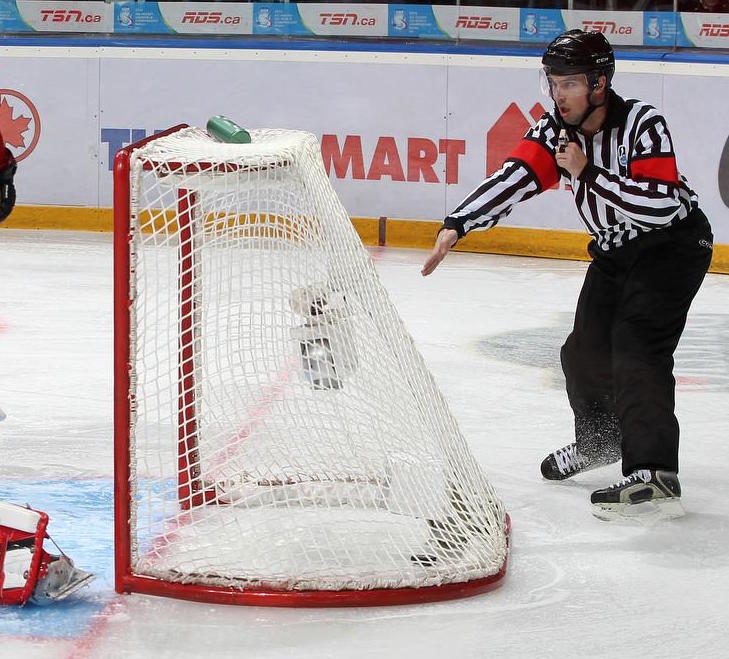
For a forward, a person in vertical black and white stripes making this signal is the most beautiful thing in the world (unless you're in the defensive zone. Then it sucks.)

The signal you want to see a ref or linesman make immediately after you shoot at goal.

A goal drought is a funny thing, in any sport. You don’t realise you’re in it, until you really undeniably are. And then it becomes extremely hard to ignore.

I guess it’s why the word ‘drought’ is well chosen as a metaphor. It hasn’t rained for a while. Then you begin to realise it has been an unfeasibly long time since there was precipitation of any volume. Then you notice the dryness of the soil, the wilting leaves on the vegetation. The percentage-full stat for the dams has been creeping while you weren’t watching, but now you are and the drop is alarming. That figure keeps creeping in the wrong direction and suddenly, you’re worried and the people with fancy cars are being told they can’t wash their cars, even using buckets, and you start seeing scenarios where it never rains again and Australia finally meets its post-Apocalyptic harsh dry Mad Max future that has always seemed a likely end game in this extreme country and never more so than when a douchecanoe of a Prime Minister waves off all science, declares climate change doesn’t exist and tells reporters how much he loves coal and thinks coal mining is a great thing for our future.

But I digress. Hockey.

A hockey friend of mine logged a Facebook post one day, which read something like: ‘643 days.’

This puzzled me for a while. After all, there was that outside chance he was discussing something unrelated to hockey. 643 days what? Since he last had a drink? Until his best gal arrives home? Until a movie he’s looking forward to is released?

But no, sure enough, fellow hockey players turned up on the thread, gently nudging and ribbing him in the comments, and it became clear he was actually counting, carefully, how much time had passed since his last goal.

This horrified me. That is not a stat I would ever want to voluntarily track. There was a time a while ago when I ran briefly at a goal a game for one short glorious spell. But then, more recently, any dev league or IHV goalscorers could have been forgiven for forgetting the number 17 existed when I was on the ice.

My goal drought had certainly lasted a while before last night’s dev league goal (and I know it’s only dev league but there are lots of very good players going around on Wednesday nights at the Icehouse, so I’m counting it as a genuine competition goal, so there).

It had never, at any point, occurred to me to count the individual days between horns blaring. I do know that after scoring three goals in my debut summer season of 2012/13 (and I can sort of remember them all, even if the sometimes sketchy recording mechanisms of hockey mean only one was officially recorded), I didn’t score at all in the 2013/14 season.

There were reasons for this, including the much-chronicled Lost Year of the Knee, which affected my mobility throughout the season and my sheer, basic ability to be able to get to the puck, or not, which clearly affects your scoring potential.

But whatever the excuses, I hadn’t hit the scoreboard for a long time. And that bothers anybody. Definitely, it bothers me. It just eats into your belief, shift after shift, easily blocked shot after missed net.

There are many kinds of forwards in hockey. It’s a fascinating part of a sport with usually a maximum of 12 forwards in a game, taking the ice in waves of three players at a time. Some forwards, even whole lines, are almost purely defensive, some are grinders, some – in the olden days of the NHL and pro leagues – are dedicated enforcers, only on the team to go beat up an opponent threatening the team’s more skilled goal scorers.

My boy, Big Cat, is mobbed by Cherokees after scoring. He got a hat-trick last night and is a pure goal-scorer when fit and firing. Pic: Luke Milkovic.

My boy, Big Cat, is mobbed by Cherokees after scoring. He got a hat-trick last night and is a pure goal-scorer when fit and firing. Pic: Luke Milkovic.

And there are the pure goal scorers – forwards who can dart and weave on their skates, can fly, and have cannon shots to targeted corners of the net, or have deft flecks to flip a puck past a bedazzled, helpless goalie. Have their heads up and their eyes open to spot a goalie moving ever so slightly in one direction, and the skill to plant the puck where he or she isn’t.

I am not one of those players. And yet nor am I a purely defensive forward. I’m old fashioned, I guess, and see some sort of responsibility as a usually Left Wing, in a decent team, to put my share of shots on net, to be able to get myself to that dangerous, buffeted slot in front of the goalie, looking for the rebound, or a deflection, while being elbowed and yanked, buffeted and stick-chopped by opposition defenders. I think, after playing for about four years, I need to be able to do something, something, on a breakaway, and I definitely should at least see the number 17 on some assists for my team, the Cherokees, or for my dev league teammates, even if I’m not scoring genuine goals myself.

But it had been a while since these things had happened and that starts to erode at your confidence and your belief, there’s no denying it. It’s amazing what one goal can do to spark you up, to make you feel like you might just maybe actually belong on the ice. As opposed to sucking, night after night.

As I said at the start, I’m not strutting; I’m breathing out, with relief. A bobbling, strategic, not too powerful shot somehow tumbling over the goalie’s stick, to sneak through the five hole. That moment when you realise it has actually disappeared behind the goalie, like Luke Skywalker watching the missile vanish into the air conditioning unit. And in the most unlikely setting of a single shift where all three of us scored, The Milkman and Big Cat bookending my goal with well crafted shots that found the mark.

I have no idea when my next goal will be, or where it will come from, but at least I now know it can happen; that I haven’t completely lost my ability to score after all. Lots of core strength work, lots of skating technique toil to eek out some speed, any possible speed, and re-enrolled in Intermediate classes, which has been fantastic because there are so many puck-handling drills, to feel the puck. Plus a change of gloves, and a new stick. Plus six drops of essence of terror, five drops of sinister sauce. All these little things plus a stroke of luck and a slice of confidence.

Now I just need it to happen in official Div 3 competition.

Fingers crossed. Which is not easy when wearing hockey gloves. Try it some time.

Going under in Paris.

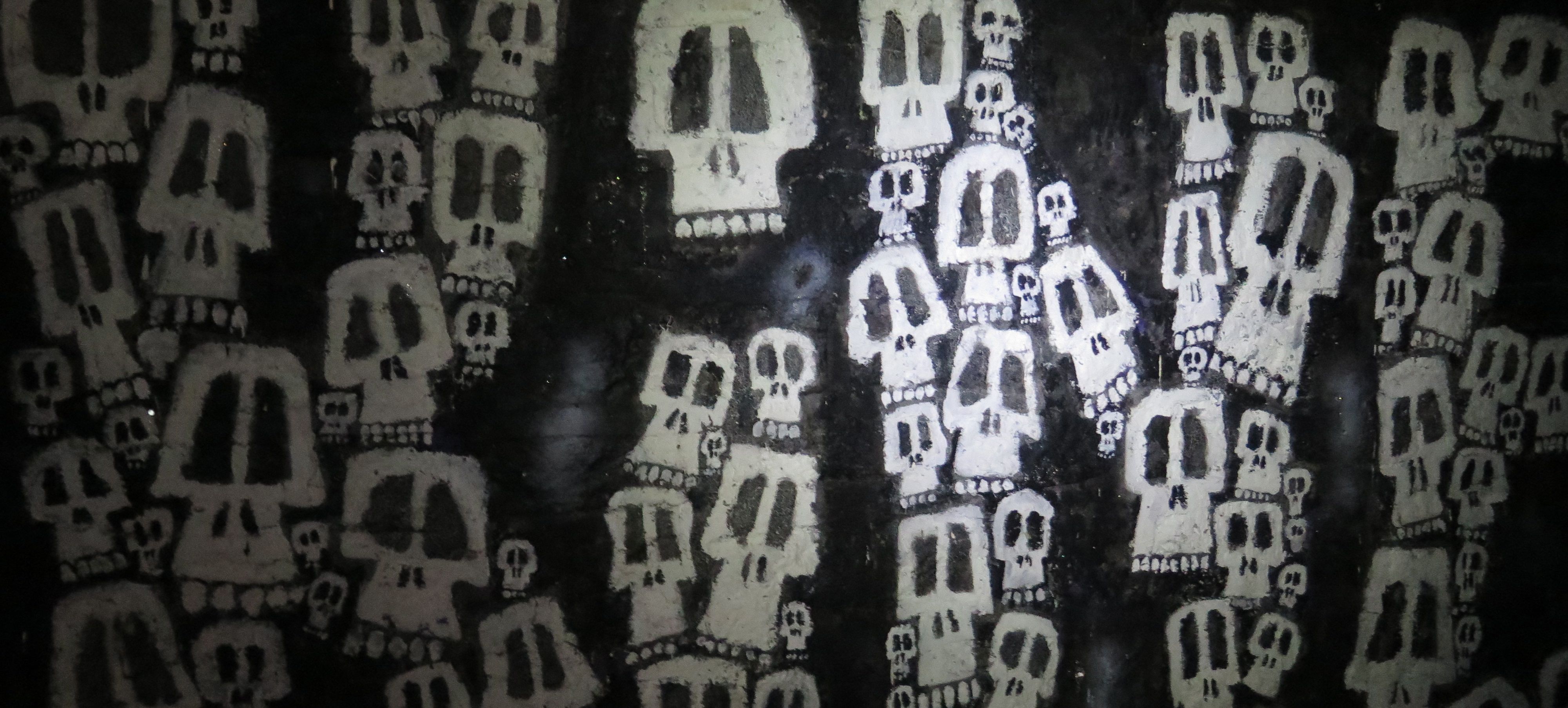
Catacombs art. Picture: Nicko

Catacombs art. Picture: Nicko

The tunnel is maybe 600 years old. At times I can walk upright; at times I have to crouch. There are parts of it where crawling on your stomach is the only option. And slightly higher parts where you can sort of crawl on your hands and knees.

Which is when I start laughing, startling my much younger ‘cataphile’ companions, who are also grunting, sweating and struggling forward.

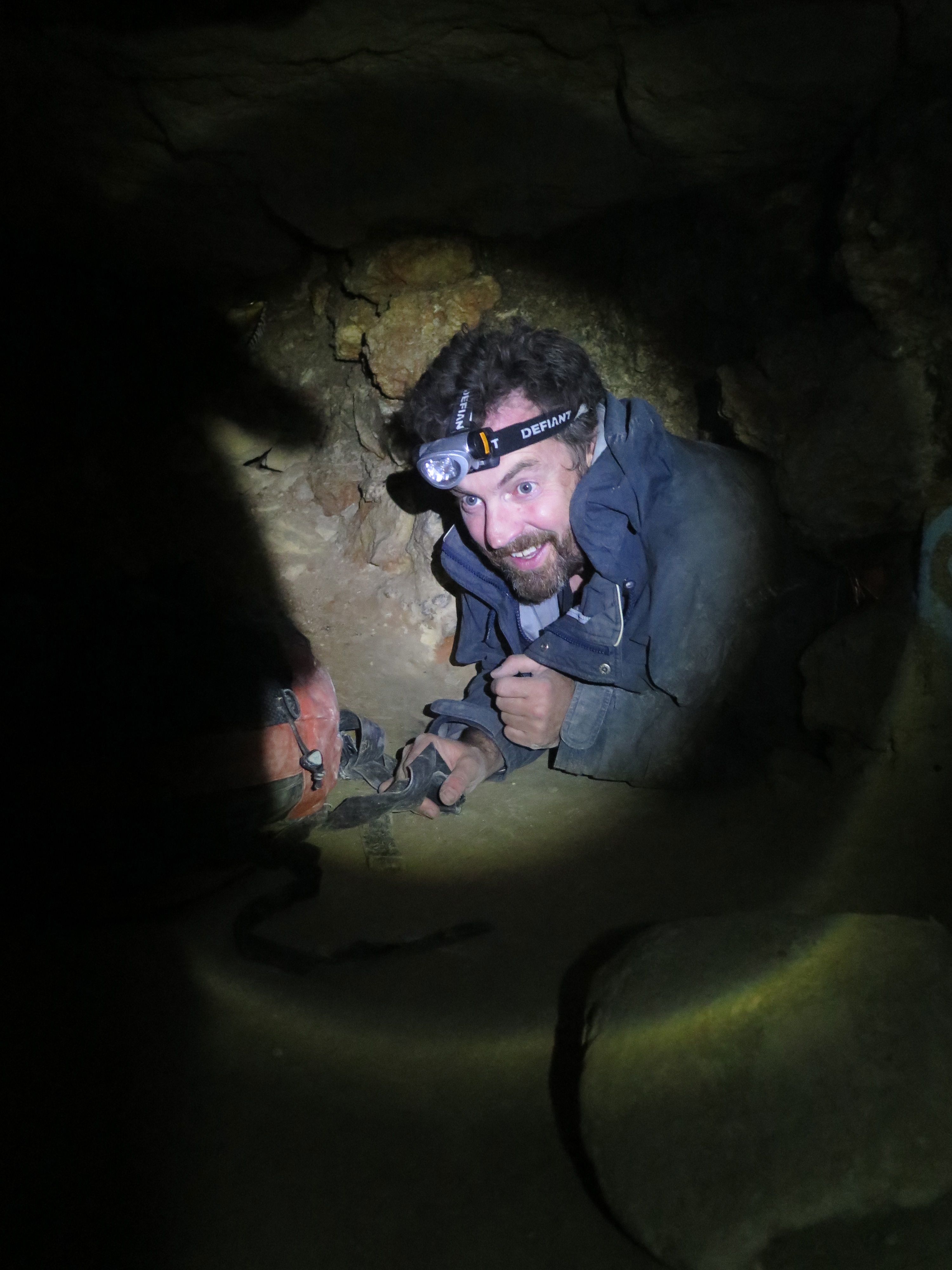
I start laughing because I realize that to get through this part of the illegal catacombs, deep under the city of Paris, I need to do what my personal trainer, Lliam Webster, and I call ‘Spider-man-ing.’ Knees out, core strong, hips low, moving forward, one hand then the other.

It’s training I’ve been doing for a year or so, week in week out, and it becomes apparent in this bizarre underground world that while I thought I was training for ice hockey, I was actually doing the perfect training for catacombs adventuring.

'Spider-man' training kicking in. Picture: 'Twist'.

‘Spider-man’ training kicking in. Picture: ‘Twist’.

My training at Fluid with Lliam kicks in everywhere. Sliding on my stomach, I use my hands to push a backpack ahead of me across the muddy clay. Isolating upper body strength and movement from my legs. In parts of the tunnels where you can’t stand upright, classic hockey stance is the perfect way to keep moving; knees bent, back straight, headtorch shining ahead.

I am with three Frenchmen, all around 30 years of age. They are true cataphiles, as they call themselves. They have nicknames so that if we are caught by the French cops, no real names are used. One is known as Syphilis, and I’m not sure I even want to know the origins of that name. Apparently, by day, he’s a doctor so maybe it’s less sordid than it seems. Another is Twist, or the Philistine. One is so stoned so quickly that I don’t bother with his name much because every time we stop, he either lights up or dozes off. He offers me drags of whatever he’s smoking but I politely decline because the illegal catacombs are NOT a place I want to be out of my head, even one per cent. I want my wits about me. We headed into this place at dusk, from a hole in a wall of a disused rail line, keeping an eye out for the gendarmes, and now it’s closing in on midnight and we are deep deep deep within the rambling catacombs tunnels. If I didn’t have a head torch, I would literally not be able to see a thing. I turn it off occasionally, just to get a sense of how dark darkness can be, when you’re 20 metres below Paris in 15th or 16th century tunnels with zero natural light.

Edging along a particularly narrow part of the illegal catacombs, below Paris. Picture: 'Twist'.

Edging along a particularly narrow part of the illegal catacombs, below Paris. Picture: ‘Twist’.

Apart from the locals, who are showing me around, there are three other guys, Israelis in their twenties. Two are trainee Rabbis, about to be ordained or however you officially become a Rabbi, when they return home to Jerusalem in a couple of days’ time. The other guy runs an abseiling business but is heading home to be commandeered into the Israeli army, for compulsory military service. We stumbled across them in the catacombs, without a map, hoping that they’d find their way back out using a compass and taking notes on when they turn right or left. To my mind, they might have died if we hadn’t happened to be down there on the same Monday night. On a weekend, a hundred people or more might sneak into these catacombs; parties are held most Saturday nights for those in the know. But this is a Monday and once your torch battery runs out, there is nothing. And the concept of turn right/turn left gets fluid as the tunnels veer and fall and rise and curve and do their medieval thing. These three had tried to abseil in earlier in the day and roped straight onto a beehive, being stung hundreds of times each. But came back and somehow did find their way in.

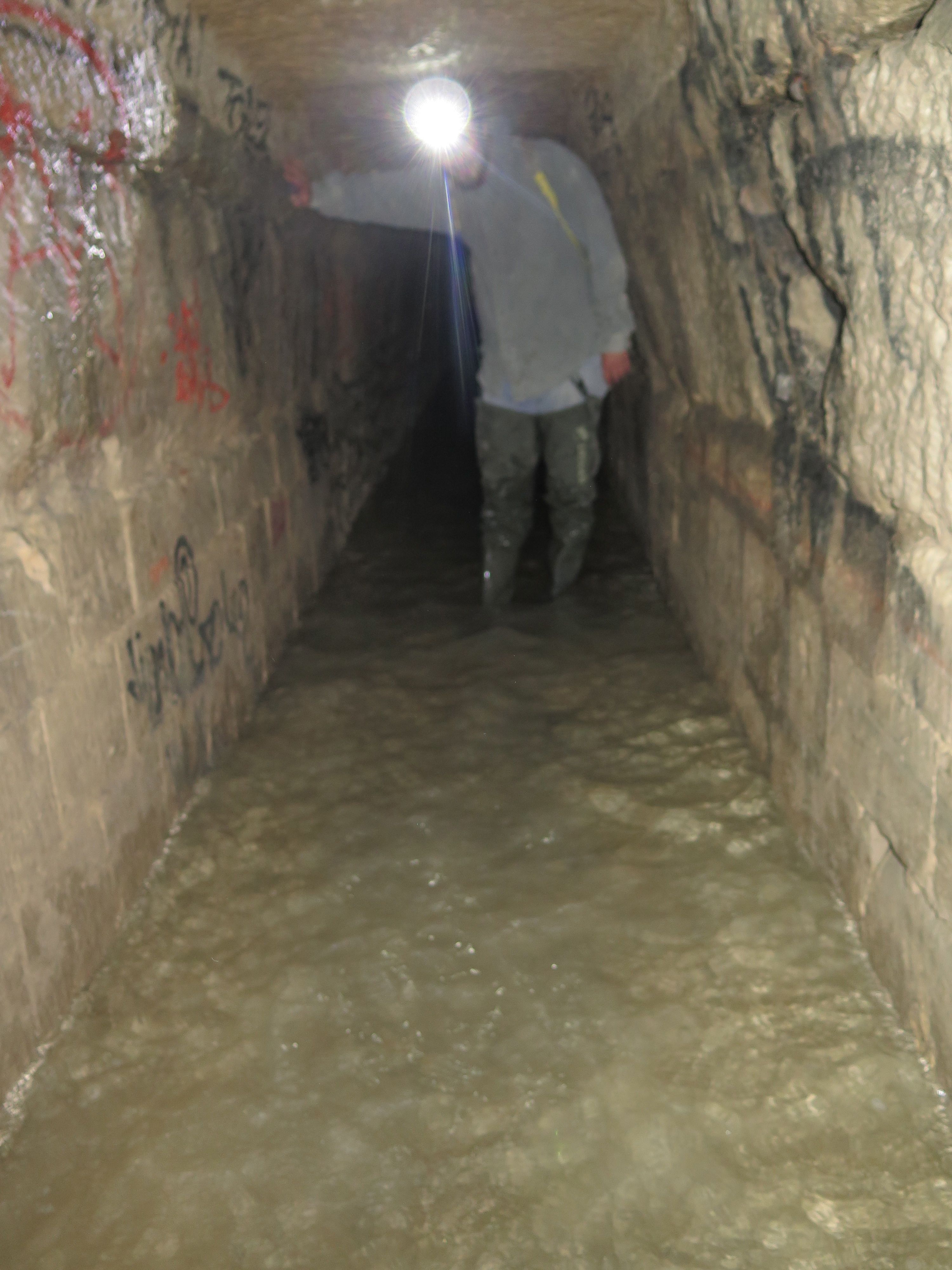
A shallow part of the water-logged section of the tunnels. Picture: Nicko

A shallow part of the water-logged section of the tunnels. Picture: Nicko

‘Can we come with you?’ they asked Syphilis and he said, ‘Well, you need to stay with us the whole way. We’re in here for six hours or more.’

By the end of the night, when we stumbled up a ladder and out a manhole into the middle of a major St Germaine street at 3 am, they were starting to realize how lucky they were to find him.

Me too, as we wander through a big party room called The Beach, with all kinds of street art on the walls, or the Santa Claus room, or past what is occasionally a cinema, or past a sobering tunnel where the roof fell in. There is a part of the catacombs elsewhere in the city that has been cleaned up, made safe and opened for tourists, but we’re in the other part – the catacombs that are officially blocked off and supposed to be out of bounds. There’s no guarantee that the exit we aim for won’t have been locked by council workers, or blocked by cops. At least, now we’re in, we know we can always hike all the way back to where we arrived, if necessary, but that would see us emerge around 7 am and I’m hoping that is not the case.

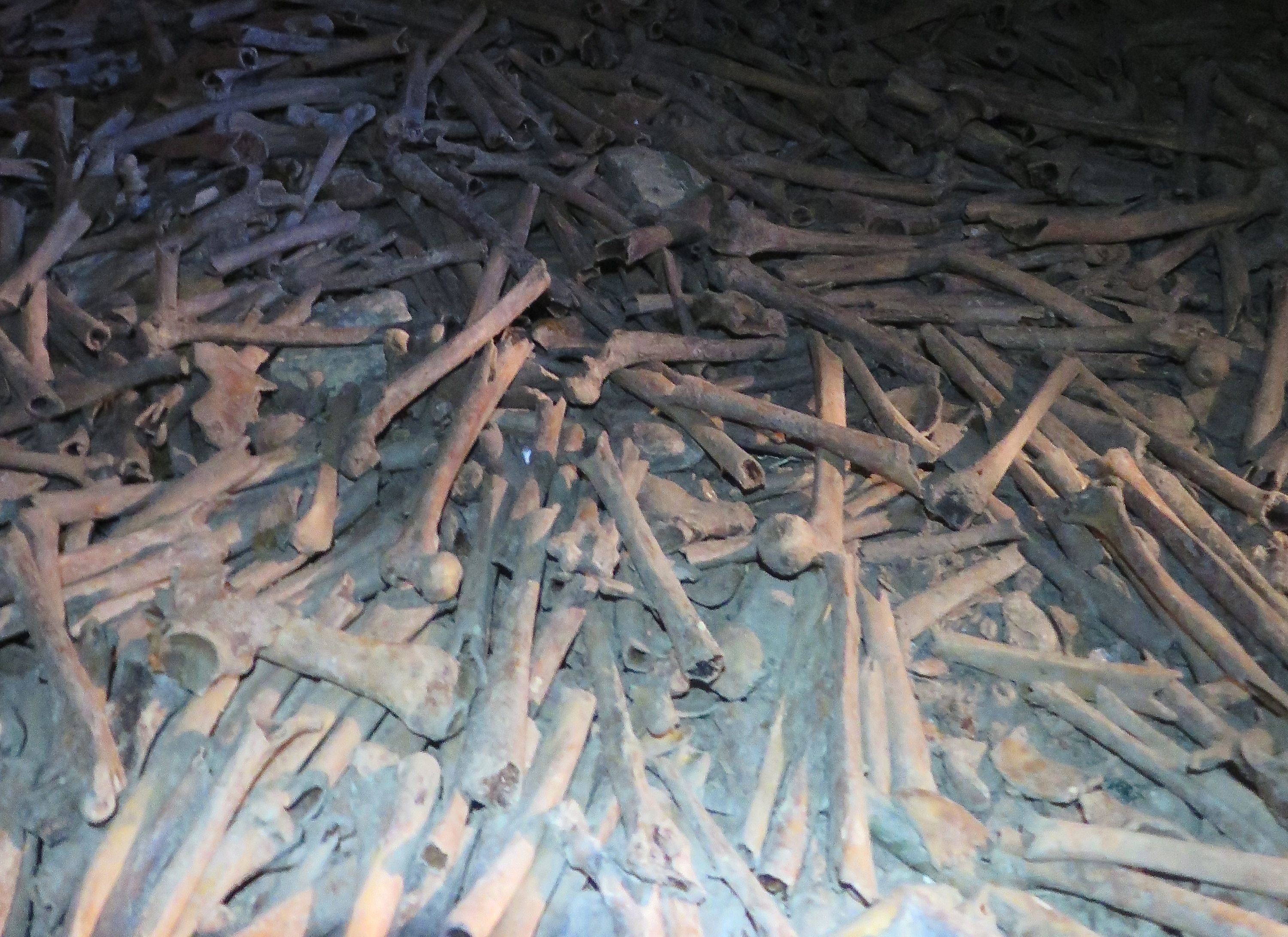
The catacombs are closed for a reason. They can be dangerous and, among other things, are apparently part of the Paris reserve water supply, so that even as we walk through parts where the water is up to our mid-thigh, it feels clean and fresh. But of course, people find their way in, and I love that there are always those who will find cracks in the city, other dimensions beyond the ordinary. Once inside, the place doesn’t feel overly dangerous, especially with a map (hello, Israel) and the right equipment. There are no rats, no spiders; there is no life at all. We walk past graffiti from the 18th and 19th century, we walk past skulls and bones. We crawl through a tiny hole into a circular room loaded with a mountain of human bones from the Cimetière des Innocents, a large cemetery that was in the heart of Paris in the 1700s and 1800s. Twist tells me that there was a plague, maybe 500 years ago, and it was blamed on the cemetery, so the bodies were dug up and dumped down here. I work hard not to step on a single bone. One of the Israeli dudes laughs, grabs a skull and pretends to be eating lunch.

Five hundred years ago, there was a plague ...

Five hundred years ago, there was a plague …

We head on to the Oyster Room, and have one of the best pic-niques of my life. Twist pulls out a dozen or so candles and we turn off our headtorches, preserving batteries. By candlelight, we drink beer, eat breadstick and pate, Camembert cheese and the awesome Petit Écolier chocolate biscuits that would be the best thing ever invented in France if it wasn’t for French women and wine. The stoner tokes and dozes, and Twist peers at a map of the catacombs, downloaded off the internet, plotting our next course. I chat about the stark difference between the word ‘normal’ in Israel and Australia with the army-bound abseiler (Him: ‘We had a war last month. Three of my friends died. It’s how it is where I live. It’s normal. You cry for two days and then you move on. My parents both carry guns. I carry a gun sometimes, to move around town. People don’t want peace. They want revenge. They want to fight.’ Me: ‘So let me tell you about Melbourne, where I come from …’)

Spongebob makes an appearance among the catacomb artwork. Picture: Nicko

Spongebob makes an appearance among the catacomb artwork. Picture: Nicko

And again, I am struck by the mysteries and wonder of my blessed life. That I have the means and contacts and spirit and ability to be sitting in a candlelit cave, deep within the bedrock of Paris, somewhere under the Jardin Luxembourg or thereabouts, chatting war and peace with a Jerusalem native while his Rabbi friends softly prays and then sings next to us. I had been genuinely apprehensive, leaving my flat and heading off to this adventure, but I have a policy that if fear is the only thing stopping me doing something, then I have to do it. So I went, and oh man, I am so glad at this moment that I did.

And as we literally crawl through tiny tunnels and I slide into holes so small I am not sure I’ll fit through, being the lead explorer at this point and needing to bend in an L-shape and corkscrew my torso to make it, feet dangling, unsure where the floor is or, shit, even if there is a floor on the other side, I give thanks for Lliam Webster and hockey and the fact that at almost 50 years of age I am fit enough and supple enough (and stupid enough) and have built enough trained core strength to be able to embrace a fucking crazy adventure like this one and come through it in one piece, smiling.

A candlelight dinner in the Oyster Room.

A candlelight dinner in the Oyster Room.

We pass a former font of the Chartreuse monks, who invented that lethal spirit. We decide it’s past 2 am and we haven’t got time to detour to the German war bunker nearby. (Urban legend has it that Hitler pissed in the toilet there.) We also can’t visit the only official underground grave of the catacombs – a gatekeeper who started walking them 200 years ago (possibly hunting Chartreuse) and one day didn’t return, his body found 21 years later in the tunnels. This trip, the cataphiles won’t make it all the way to under the military hospital, where punk concerts have been known to happen.

It takes both Syphilis and Twist to push against the solid metal manhole cover and release us into the early morning air of a deserted Paris street. Covered head to toe in yellow clay, seven men emerge from the ladder and run for the darkness of a nearby sidestreet. No yells. No sirens. No flashing lights. We jump a fence into the deserted jardin, peel off our wading boots and rainjackets, stash headlamps and I try to regain some sense of normal appearance for the 4 am bus ride back to where I’m staying. My hair is caked in yellow clay and dust. Twist and I share one last beer, grinning at one another like maniacs, like brothers who have shared secrets, like friends who have seen things most don’t get to see, like outlaws who have somehow, against all odds, escaped the law.

And the next day, I avoid a trip to the Eiffel Tour with my travelling companions, because I’ve climbed it before and anyway, oh God, I need to sleep. But my body isn’t even that sore, given what I put it through underground. My hockey training has come through again. When I needed it. In the most unlikely circumstances.

Resting in not much peace. Picture: Nicko

Resting in not much peace. Picture: Nicko

Today, I’m back at my desk, more than a little jetlagged, and tomorrow night I’m back at the Icehouse, wobbling around in yet another round of development training. On Friday, the Detroit Red Wings begin another NHL campaign, playing the Bruins, and then that night I dress for a practice match with my summer league team, the Cherokees, to see if all my fitness work will translate into actually being a better competitive player.

In other words, life is back to normal, but I have a whole new batch of memories to carry me along.

Here’s to hockey, and to Lliam Webster, and to keeping fit, and to embracing adventures when you can. This was a good one.

Ah, Paris.

Ah, Paris.